Get unlimited access to the best of MySeaTime for less than ₹100/week. Become a member

Members only

Here Is All You Wanted to Know About Draft Survey Calculations

96
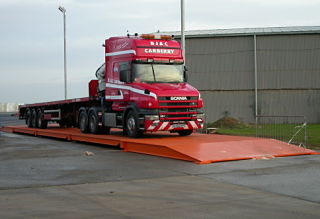
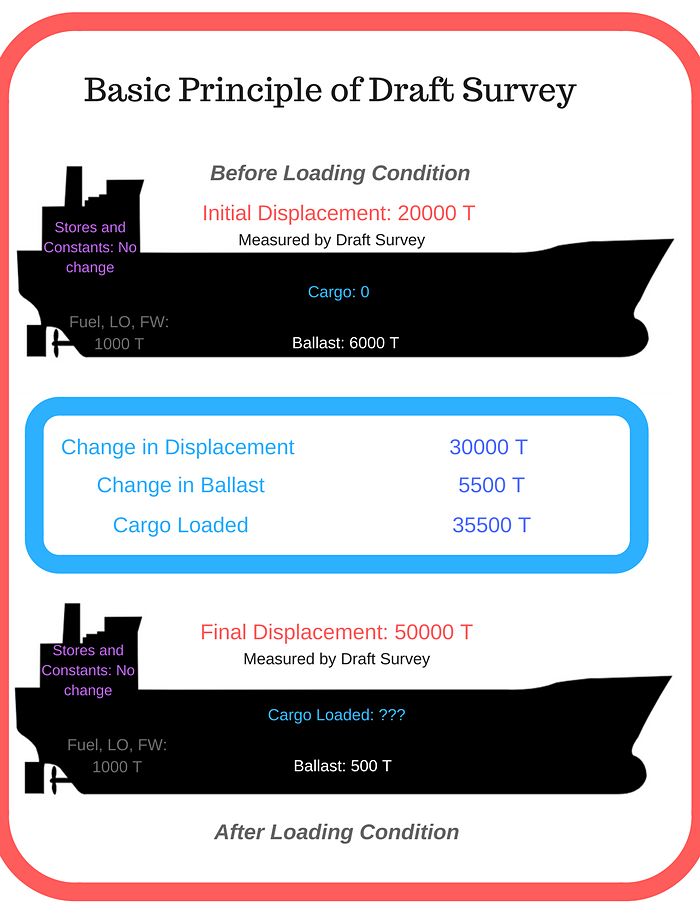
Draft survey calculations Have you seen a truck weighing bridge ? Do you know how it works ? Weigh bridge It weighs the empty weight of the truck and then the loaded weight. The difference is the weight of the cargo on that truck. Well draft survey uses a similar principle to measure the cargo loaded on board ships. With draft survey we measures the initial weight (displacement) of the ship and it measures the final weight (displacement) of the ship after loading. The difference plus all the weights that were taken out (like ballast) will be the cargo loaded. Basics of draft survey The only difference between weight measurement in case of truck and ship is that for later the calculation is not that simple. So in this post I will discuss about how to go about measuring the cargo quantity with draft survey. 1. Why Draft survey ? On tankers, the measurement of cargo quantity loaded is simple. We know the density of the cargo and we know the volume. It is easier to know the weight of the cargo loaded. But with cargoes like coal, we canno...
Join now to access this article and much more.

Admin has placed this article behind a paywall, making it accessible only with a paid membership, which offers numerous perks:

  • Contribute to creating a platform for reading and writing without ads.
  • Enjoy all content here, including exclusive articles for members.
  • Gain access to all exclusive articles for members.

Comments (96)

  • Sunil Bhatia March 15, 2017
    I just went thru your article on draft survey. Well depicted and explained. Good guide for people actually doing it specially Surveyor appointed to do so, as many a times they do not have perfect knowledge and may get carried away ...thanks for sharing
    6
    Rajeev Jassal March 28, 2017
    Thanks Sunil..
    Achiko Tevzadze April 6, 2019
    Gd day mr jassal. Its amazing blog. I just want to ask ,how you get this displacement 30702.28 ? My calculations is less. Many thanks
  • rafai francois March 22, 2017
    ffff
    0
  • John Albrecht March 25, 2017
    Fantastic blog post! I love your website, excellent information.
    1
    Rajeev Jassal March 28, 2017
    Glad to hear that John...
  • Rohan Moorthi March 29, 2017
    Hi Rajeev, Brillaint article. Was just wondering if the above applies to the below problem: A transport barge is 130 metres long and floats at draughts of 6.0 m forward and 6.5 m aft. It is to load a steel casting of 250 tonnes in a position on deck which is 80 m from the aft perpendicular. The barge has the following hydrostatic data:- MCTC = 125 TPC = 25t Centre of floatation is amidships. Calculate the final draughts after completion of loading. Will appreciate your assistance.
    2
    Ddenis October 14, 2020
    Hi Rajeev / Rohan, how did you go with this calculation? I'm interested in this outcome?
    Sachin J.Mesta August 18, 2021
    Hi Sir, Many thanks for your presentation its really help me in the area of draft survey.
  • Denis April 21, 2017
    Dear Capt. Rajeev Jassal! Thank You for this post! I just want to ask one more question. What to do, if we have thickness of keel plate in our calculations. For example, thickness of keel plate is 22mm. Base line is line above keel plate. Should we substact this value when calculating true draft at perprndiculars or when calculating Mean of Means? Or we shoud add this value? Thank You!
    3
    Jakub April 26, 2017
    Look on www.draftsurvey.org download software and create new ship, there is a nice help where is perfectly explained how is it with keel thickness correction. Generally this correction is used to match two drafts: read drafts from draft marks and hydrostatic table drafts column. Usually draft marks has datum welded on the bottom line of keel plate. So once you calculate MMM draft you have a draft from 'bottom edge' of keel. Now you open your hydros. table booklet and you like to read displacement. There is a column with drafts from e.g. 2.50 to 15.00 m, these drafts could be from bottom or top edge of keel plate. This information is always included in hydrost. table. (here in Mr. Rajeev article hydros. table fragment has drafts from top of keel plate - see picture). In case that read draft is from bottom of keel plate and drafts in HT column from top of keel plate you have to subtract the keel thickness from MMM draft. In case that you will have hydros. table from bottom of keel plate you are omitting this correction.
    Denis April 27, 2017
    Thanks for confirmation! I thought in the same way) And another way, in case we have drafts at perpendiculars and we need to calculate drafts at at draft marks we should add keel thickness))
  • Cesar April 24, 2017
    Sir, my question is: is the formula for getting apparent trim is constant: trim = aft draft - forward draft , Is that formula constant ??? Or no constant formula just apparent trim is derived from always subtracting the smaller draft into the bigger draft.... for example: aft draft = 7 m fwd draft= 5 so trim= aft - fwd = 2m or aft draft = 5 fwd draft= 7 m so trim= fwd - aft = 2m i just want to clarify this, sorry for stupid question .. thanks.
    3
    Jakub April 26, 2017
    First trim correction: TRUE TRIM always minus to stern, everything running left with minus, everything running right is plus. E.g. LCF is longitudinal center of flotation, it mean distance between AP (aft perpendicular) and center of flotation (f), the value is always positive because running right from AP. The distance from midships to flotation (Xf) = (LBP / 2) - LCF, in this case when running left from midships (LCF LBP/2). The first trim correction will be positive when, Xf is positive and Trim is positive or Xf is negative and Trim is negative, otherwise the first trim correction is positive. So remember left and right hand rule and you cannot make mistake. Same in Astronavigation what we are using is 'right' like (E) as + and on the other side 'left' (W) as minus. Do not implementing this crazy rules bigger draft and trim to bow or stern. Follow the maritime standards.
    Arceeti M. January 28, 2020
    YOU ARE PRETENDING TO BE AN EXPERT YET YOU KNOW NOTHING. EVERYTHING YOU WRITE IS WRONG. PERIOD
  • Jakub April 26, 2017
    Nice article, very comprehensive. I have small remark, your logic around first trim correction is little off (results are ok, no mistakes), but the logic is off. Exactly this approach to first trim correction is making mess in students heads. Nobody properly follow Cartesian coordinate system and this is the main problem in determination of the positive and negative value of trim, LCF, Xf and finally first trim correction. If your are looking for best software, try www.draftsurvey.org
    0
  • Jakub April 26, 2017
    First trim correction: TRUE TRIM always minus to stern, everything running left with minus, everything running right is plus. E.g. LCF is longitudinal center of flotation, it mean distance between AP (aft perpendicular) and center of flotation (f), the value is always positive because running right from AP. The distance from midships to flotation (Xf) = (LBP / 2) - LCF, in this case when running left from midships (LCF LBP/2). The first trim correction will be positive when, Xf is positive and Trim is positive or Xf is negative and Trim is negative, otherwise the first trim correction is positive. So remember left and right hand rule and you cannot make mistake. Same in Astronavigation what we are using is 'right' like (E) as + and on the other side 'left' (W) as minus. Do not implementing this crazy rules bigger draft and trim to bow or stern. Follow the maritime standards.
    0
  • Surawee May 9, 2017
    I just wonder why so many site talk about draft survey but few or almost none mention about Heeling correction and deflect ( hogging and sagging) since we accept condition of ship for draft survey should not has list more than 0.5 degree. In real situation it's can easily found 1-2 degree listing sometime.
    2
    Ritesh kaushal July 21, 2017
    The qtr mean draft is calculated to take care of hull deflection.As the heel correction is very small and ships do generally sail upright ,heel correction is neglected.
    eric September 23, 2017
    quatermeans does not take care off hull deflection, Quatermean is only calculated to find the draft at the point of the Xf. heel correction should not be neglected but is subject to discussion, specially then a claim or LOP is imminent it should be calculated as wel as an exact deflection calculation.
  • Ashutosh sharma September 11, 2017
    Sir if it is written in stability booklet that ,the draft is measured from the upper edge of keel..do I need to apply keel correction...Which h draft is used for draft survey ,the moulded draft ?
    0
  • yousri tawfik October 11, 2017
    great, Thank you all for enriching the blog with valuable information
    0
  • Md Raihan Hoshen October 24, 2017
    Tonnes of thanks!!!
    0
  • Oleg November 21, 2017
    I followed calculations (to check my many-years-old excel form) and got different figures for LCF and TPC as well as 2nd trim correction values. Manual re-check didn't help me. Could sb check, please?
    0
  • Fabian November 30, 2017
    How do you know that the second trim correction is not applicable? And when is it applicable?
    0
  • A.D.Kajarekar December 5, 2017
    Question: What will be the draft when the barge is empty? Barge details are 8000DWT(YXH- 2000), Length 122.25M, Breadth MLD 20M, Depth MLD 7.2M, Design Draft 4.8M, Scantling Draft 5.2M, Dead weight 8000DWT, Gross tonnage 6000T.
    0
  • Vl January 8, 2018
    Dear Rajeev Jassal, is it all this what deck officers do routinely arriving/departing? Or it is being done just for the sake of surveillance by a surveyor? Thank you sir.
    2
    Retired Seamen / Surveyor March 27, 2018
    Based on my experiences, Draft survey always being done by Deck Officer together with Surveyor. . . . In this case, Deck Officer means Chief Officer, but in some cases by the Ship's Captain
    Retired Seamen / Surveyor March 27, 2018
    I'm sorry. . . . .Yes, routinely loading/ unloading
  • Laur January 10, 2018
    Not all the time negative constant means something is wrong with measurements/calculations. How about: -steel stencions on log cariers removed and light ship value not updated - decks inside holds and light ship value not updated - chief engineer "forget" to declare all fuel on board - lifting devices removed during vesèls life time and again forget about the light ship value to be updated - vessel previously run aground or with bad reconstruction - vessels showing big hogging from other various reasons I'm not saying not to check again, but sometimes this could be the true: negative constant.
    0
  • Capt.Zubair Aslam February 10, 2018
    Very nice n well written article. I appreciate your good effort. We shoulf always share our knowledge.
    0
  • Mavoungou Eugene March 24, 2018
    Thanks for clear explaination, the end was difficult caus'of many calculation before that. But the work was well dealing, just thanks captain. Eugene Mavoungou. Deck officer
    0
  • Royce April 6, 2018
    Hi sir RAJEEV my question is Vessel L.O.A 228.99M AND LPP 222M DRAFT FWD 7.50M AFT 8.50 MEAN DRAFT 8.00M MID DRAFT FWD DRAFT MARKING IS 4.00 FROM FWD PERPENDICULAR AND AFT DRAFT IS 9.85M FROM AFT PERPENDICULAR APPLY THE TRIM CORRECTION OF YOUR APPARENT DRAFT FIND THE QUARTER MEAN DRAFT
    0
  • Captain Mahbub April 28, 2018
    Nicely Explained.
    0
  • tajudeen May 6, 2018
    here is my question......... the plan area of a figure is 207.13m... find the volume of astern with hight of 1.25.....
    0
  • Mazharul islam Bappa May 21, 2018
    Assalamu alaikum.Dear Sir,How do i understand + or - 1st trim correction?When time 1st trim positive or negative i don't konw?please sir,Known to me?
    0
  • majed slman June 5, 2018
    Fine and wonder full.
    0
  • LAI HOI June 17, 2018
    Please tell me, if the barge list to Starboard 2 deg. with barge breadth 24 m. Port side draft is 5m. how to cal. the starboard draft ? Thanks
    0
  • JONEL July 7, 2018
    Capt. I am an avid fan of you, but for this topic I just want to know how do you come up with the figures for interpolation of LCF and TPC because it doesn't coincide with my computation, e.g. the given figures for LCF of 7.45 and 7.5 drafts were 1.0465 and 0.9555 respectively. My computation goes like this, I would subtract 1.0465 and 0.9555 so I would have 0.091 then divide this for 5000 units, therefore giving me 0.0000182 for each unit. I will multiply the later to 675 so I would have 0.012285. Subtract this from 1.0465 so I came up with the answer for interpolation of 7.45675 to 1.034215, which is quite too far from your given answer (0.9851).
    0
  • Rizwan Ahmed July 18, 2018
    Thanks Sir, very nicely expalined.
    0
  • suryakant sutar August 6, 2018
    thanks for Nicely Explained
    0
  • mr d August 10, 2018
    sir how can i get the port side draft if the manometer reading is list to portside is 10cm, startboard draft F=8.2 A=10.5 M=9.35. thanks
    0
  • Cisse August 26, 2018
    Nice
    0
  • Dr December 3, 2018
    Hi Cpt Basic draft survey was well expl. I would like to now how can i apply ballast correction when i dont have ballast correction book . Thnx
    0
  • James Petty January 9, 2019
    Happy New Year! We specialized in Bank Guarantee {BG}, Standby Letter of Credit {SBLC}, Medium Term Notes {MTN}, Confirmable Bank Draft {CBD} as well as other financial instruments issued from AAA Rated bank such as HSBC Bank Hong Kong, HSBC Bank London, Deutsche Bank AG Frankfurt, Barclays Bank , Standard Chartered Bank and others on lease at the lowest available rates depending on the face value of the instrument needed. We will be glad to share our working procedures with you upon request to help us proceed towards closing deals effectively. Email: jpettyinstrumentlender01@gmail.com Skype: jpettyinstrumentlender01 Regards James Petty
    0
  • maged slman January 22, 2019
    Thank you very much.that is good explanation.
    0
  • Capt Muhammad Navaid shuja February 5, 2019
    Very nice. Well explained
    0
  • miladi samir April 6, 2019
    The 2nd trim correction must be demonstrated for peaple using draft survey . Draft survey is accepted within only small trim about LBP/100 max . This means the Change in weight from evenkeel to very small trim . Ex : trim 3 m gives 2nd correction 9 times as much compared to trim : 1m in the same condition .
    0
  • daho kamel April 28, 2019
    I need an address of a school (institute) that provides training on the draft survey in French-speaking countries in Europe thanks in advance.
    0
  • vikash kumar June 19, 2019
    sir why 2nd trim correction is always positive
    0
  • Yanga July 14, 2019
    Sir, If you add the loadicator method too , It will be more complete guide. Plus , I want to know , what will be the correct weight of ballast , since the density of ballast water varies from which time it is taken and from which place it is taken from. And Also , Now , The BWMP also makes mandatory for exchange of Ballast water which makes it more complicated.
    0
  • Chris August 2, 2019
    Hello, very informative article. However, does anyone know where to find Draft survey programs?
    0
  • Navneet October 25, 2019
    Sir, I have got the draft of port side and vessel is listed 1 degree towards starboard side. Then how to calculate the draft of starboard side.
    1
    wim February 28, 2020
    0.01746 x angle x shipsbeam = diff in draft Ps and Sb
  • Berko November 23, 2019
    Interpolation seems to me wrong can you recheck and if it has mistaken pls recorrect it because people are also calculating via your values, thanks.
    0
  • Hyginus N. A November 24, 2019
    This is a masterpiece and a well articulated writeup. I've read two of your great work on cargo survey- Cargo calculations with ASTM Tables and this one. How I wish you were my classroom teacher. I indeed appreciate you for sharing your knowledge with us. Please do you have more articles on cargo survey for us? Could you let us know the topics of the articles? Once again, thanks a million times.
    0
  • Hyginus N. A November 24, 2019
    This is a masterpiece and a well articulated writeup. I've read two of your great work on cargo survey- Cargo calculations with ASTM Tables and this one. How I wish you were my classroom teacher. I indeed appreciate you for sharing your knowledge with us. Please do you have more articles on cargo survey for us? Could you let us know the topics of the articles? Once again, thanks a million times.
    0
  • Hyginus N. A November 24, 2019
    This is a masterpiece and a well articulated writeup. I've read two of your great work on cargo survey- Cargo calculations with ASTM Tables and this one. How I wish you were my classroom teacher. I indeed appreciate you for sharing your knowledge with us. Please do you have more articles on cargo survey for us? Could you let us know the topics of the articles? Once again, thanks a million times.
    0
  • KHALED December 16, 2019
    Fantastic blog post! I love your website, excellent information
    0
  • KHALED December 16, 2019
    Fantastic blog post, excellent information
    0
  • jobin December 21, 2019
    sir, could you please explain first trim correction equation, the one which you explained (trim(cm)x Lcf x tpc )/lbp but the video explains (hf x trim) / lbp and some other explanations are (trim x hf x tpc x 100)/lbp....which one is reliable pls explain
    0
  • Taj mohammad January 11, 2020
    Thanks for providing informatin about draft survey
    0
  • Ihor February 1, 2020
    Iam about to 1st trim correction. According to your rule inside of green square the 1st correction must be positive if stern trim and LCF is aft of m/s. But in the calculation you present here LCF was found 0.9851, the number is positive it means LCF is located front of m/s. Why the 1st trim correction in your calculation is positive if trim to left side and LCF to right??? Thanks.
    0
  • Sahil Pawar February 18, 2020
    I would like to know the correct procedure to apply first trim correction....First trim correction can be applied to displacement obtained from quarter mean draft by formula (LBP/2)-LCFXTRIMX100XTPC/LBP OR by applying first trim correction by formula (LBP/2)-LCFXTRIM/LBP to get true mean draft TMD nd therefter get corresponding displacement from True mean draft TMD. Kindly clarify this doubt.
    0
  • Aleksandrs A April 12, 2020
    Dear Capt. Rajeev Jassal, What do you think about the new SAFETY method of Draft Survey, which will allow you to read the vessel’s Draft from the screen of your mobile phone staying on deck of the vessel? Please open – www.alexxpluss.com
    0
  • Suraj May 5, 2020
    Sir why we calculate ballast volume with apprent trim and not with true trim?
    0
  • Juan ALVARADO June 16, 2020
    It seems there are 2 errors in the example above, In the first trim correction the LCF interpolation. In second trim correction the trim was not squared. Can you check?
    0
  • Rogerio Freitas June 25, 2020
    Is there a rule or rule that excludes the obligation to calculate a ship's constant before starting a loading operation?
    0
  • Marybee July 10, 2020
    Dear capt. Thank you for your good post. I have one question. If ship have list and trim, Mean draft will be using when checking full load line? Or Q/M draft?
    0
  • David A August 6, 2020
    Thank you Captain for sharing your knowledge and experience. This article has further enlighten me.
    0
  • jasmar August 31, 2020
    where did you get this LBP equal to 174 you use to calculate the 1st trim correction thus the value of LBP is 155?
    0
  • skumar September 14, 2020
    nice and clear explanation. Very useful. Thanks
    0
  • Alex September 14, 2020
    My friend, good day! As I can see from section 4, you find Your displacement based on trim of 2.3 but in this case you don't need to calculate 1st and 2nd trim correction any more!!! If You still use 1st and 2nd trim correction then You should find your displacement in section for trim 0. May be I'm wrong, so I will be happy if will comment. Many thanks in advance!!!!
    1
    MIKE MIAO July 29, 2021
    YES, I think so. this made the correction twice.
  • Jack September 28, 2020
    what I wanna say is exactly the same.
    0
  • FAISAL November 26, 2020
    Sir, I have got the draft of port side and vessel is listed 1 degree towards starboard side. Then how to calculate the draft of starboard side.
    0
  • Nouar February 8, 2021
    Thank you very much.that is good explanation.
    0
  • Hari April 10, 2021
    Thanks for the effort and time put in to explain each and every aspect in a very simple manner.
    0
  • Peter April 19, 2021
    Please help me.. 1.what are the actions are you required to take when you found overdraft condition. 2.what action is/are important to take to minimize loss/damage after it happens. 3.in order to prevent same incident in the future what kind of training/assessment/screening for seafarer by company do you think necessary?
    0
  • OKPODUDU SAMUEL April 20, 2021
    Thank you. I enjoy the little I glance through Please kindly send me the written paper for proper study. (I want it) Thanks again
    0
  • KONSTANTINOS PSOMIADIS May 31, 2021
    Draft survey is wrong because in this example table of korea vessel trim corrections already included in the tables except if you take displacement at 0 trim then you need to calculate trim corrections
    0
  • Miladi samir June 18, 2021
    Thr 1st & 2nd trim correction have mathematical demonstration. NOMOTO formula requiring deep knowledge to get through I suggest that studies trial from the whole partipants to explain that 2 formulae are not random in use. Regards Miladi samir Tunisia
    0
  • Jitendra August 2, 2021
    Dear Sir, Good Day! Thanks for draft survey to explained in very easy method. Sir I have one doubt ,in MBC surveyor came onload and he did always trim + in loading condition and in discharge condition always - ,I ask why but he not Abe to explain me. Kindly expand Sir Thanks & Best Regards Jitendra Gupta
    0
  • JM August 3, 2021
    Capt sir, thank you for creating such informative and detailed posts on your page. Apart from your page, there seems to be very little online reference regarding our profession. You are truly a godsend, sir.
    0
  • Vk October 4, 2021
    Hi Rajeev Good day. Gone through all the posts, very well explained. Just one quarry? If there are no trimming tables on board, how to you calculate to achieve a required departure trim to a certain mid ship draft by using hold LCG's and Lcf method. If you know the formula, appreciate sharing it. Thanks. Vk
    0
  • mary November 23, 2021
    Hi, thank you so much for this insightful post. I do also have a suggestion for people who want to lose weight, you can try this weight loss product. It really helped me a lot to get a fit body. https://www.superproductsreview.com/get/eatstop
    0
  • Bestpsychichealers January 28, 2022
    Nice blog.
    0
  • omais ahmed May 10, 2022
    I’ve read a few excellent stuff here. Certainly worth bookmarking for revisiting. I surprise how a lot effort you place to make this sort of excellent informative website. from satta fast
    0
  • roger October 20, 2022
    I have understood the first trim correction based on the video you have shared. but how about the derivation of 2nd trim correction? I hope that you would share also the video of 2nd trim correction. thank you.
    0
  • Sandeep May 29, 2023
    Sir my summer draft is given 12.80 moulded and my hydrostatic particulars also have displacement for moulded draft, but my drafts on ship sides are marked from bottom of keel plate, my keel thikness is 0.018m, so when loading up to summer draft so i can load up to 12.818m visual ship side drafts..
    0
Capt Rajeev Jassal

About Capt Rajeev Jassal

Capt. Rajeev Jassal has sailed for over 24 years mainly on crude oil, product and chemical tankers. He holds MBA in shipping & Logistics degree from London. He has done extensive research on quantitatively measuring Safety culture onboard and safety climate ashore which he believes is the most important element for safer shipping.

More like this

In blog, Ship Navigation

5 Confusing Terms of Ship Navigation and its Clarification

If it wasn’t about safe navigation, no ship would reach its destination safely. But safe navigation is not only about steering…

In blog, Cargo Operation, Ship Safety & Security

5 Tanker Terms That Can Help You in Being Safe On Tankers

Did you know a rich flammable mixture can ignite with just 1 Joule of energy ? If that does not…

In blog, Cargo Operation

A step by step guide of how to operate ODME and principle of its operation

I wrote a brief post about ODME some time back but this post is going to be in detail. More…

In blog, Marine Conventions

A Basic and Simple Guide of Civil Liability Convention 92

Let me tell you a story. A ship loaded a cargo of crude oil from Mina-Al-Ahmadi and was bound for…

In blog, Cargo Operation

The Most Comprehensive Yet Simple Guide of Static Electricity

Static electricity is kind of big deal on tankers. If you think it is just a hypothetical term, you would…

In blog, Marine Conventions

Ship Energy Efficiency: Here is All You Need to Know

Energy efficiency is the big deal these days. If we use less energy, not only we save the energy but…