Get unlimited access to the best of MySeaTime for less than ₹100/week. Become a member

Members only

5 Questions that can help in Understanding of Squat effect on ships

107
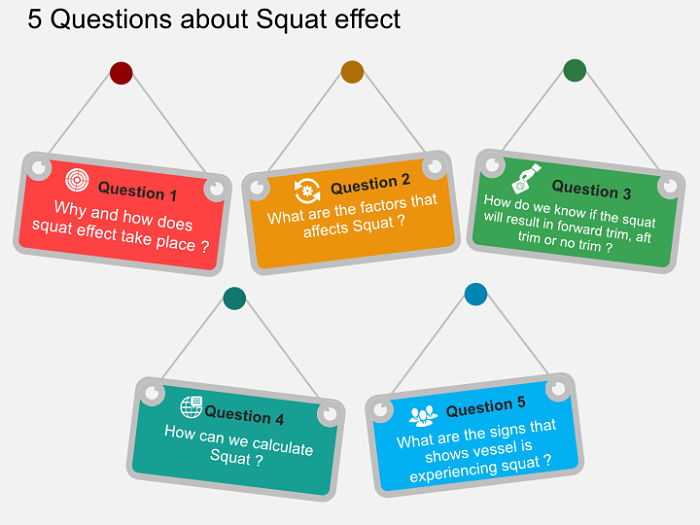
Squat on ships Years back when I first came across the term squat, frankly I failed to understand it. Well if you just want to know the mathematical formula and calculate the squat, it is no rocket science. But to answer questions like "Why do squat effect take place" may not be easy to understand. Are you too in the same boat ? Most of us know that Squat is the decrease in ship's under keel clearance due to vessel's movement in the shallow water. And it is not a theoretical thing, it is a real thing. Incident of sinking of RO-RO vessel "Herald of free enterprise" was the result of squat. But squat is not always bad. In 2010, passenger vessel "Oasis of the sea" used the squat to its advantage. It allowed squat to reduce its air draft. This helped the vessel to safely pass under a bridge, which otherwise was not possible. Incidents like these show how important the knowledge of squat is. But there are many questions related to squat, answers to which are sometimes difficult to find. In this post I will try to answer five of these questions related to squat that mariners usually ask or enquire about. 5 Questions about Squat effect
Join now to access this article and much more.

Admin has placed this article behind a paywall, making it accessible only with a paid membership, which offers numerous perks:

  • Contribute to creating a platform for reading and writing without ads.
  • Enjoy all content here, including exclusive articles for members.
  • Gain access to all exclusive articles for members.

Comments (107)

  • Vivek Kothambath July 21, 2016
    Thnx. Gud explanation
    1
    Rajeev Jassal July 21, 2016
    Glad you liked it Vivek..
  • Rakesh July 22, 2016
    Very clearly explained sir.....Thank you.
    1
    Rajeev Jassal July 22, 2016
    Glad you liked it Rakesh..
  • Capt. Vijay Kumar Sharma July 22, 2016
    A very comprehansive explaination. Nothing left to doubt
    1
    Rajeev Jassal July 22, 2016
    Thank you Capt Vijay for your kind words..
  • Vinay Singh July 22, 2016
    Just one question.. Can there be better explanation than that ? And the answer would be NO.. Thanks for your great efforts.
    1
    Rajeev Jassal July 22, 2016
    Happy that you liked it Vinay...
  • Rajdeep Singh sabharwal July 22, 2016
    Great explanation sir
    1
    Rajeev Jassal July 22, 2016
    Glad you liked it Rajdeep..
  • Capt Sanjay Prasad July 22, 2016
    Thanks Capt Rajeev for one more marvel. Your dedication is commendable. Very clearly explained and nicely presented.
    1
    Rajeev Jassal July 22, 2016
    Thank you Capt Sanjay for your kind words. People like you reading this is the fuel required for the hard work..
  • Siddhant chaturvedi July 23, 2016
    Very well explained sir.... it almost cleared all of my ambiguity , about squat
    1
    Rajeev Jassal July 23, 2016
    I am glad that it could be of some help to you Siddhant..
  • Naval Aranke July 24, 2016
    Good work on the blog Rajeev!
    1
    Rajeev Jassal July 24, 2016
    This comment coming from you mean a lot to me Sir. Thanks a lot Sir.
  • Akshay July 24, 2016
    Clearly understood.Thankyou
    1
    Rajeev Jassal July 24, 2016
    Glad you liked it Akshay..
  • Selambharasan July 24, 2016
    It was clear cut explantion sir ji
    1
    Rajeev Jassal July 24, 2016
    Thank you for reading Selambharasan..
  • vamsi July 30, 2016
    nice explanation cap
    1
    Rajeev Jassal September 5, 2016
    Thank you Vamsi..
  • Alejandro Henao September 3, 2016
    Thank you so much for your clear an compleate explanation . I would like to add, acordinly with some authors the squat will be at the head or stern with a ship trim by stern acordinly with the amount of the static trim by stern....static trim by stern leads to squat by stern ...it is no a fix rule.... Thank you.
    1
    Rajeev Jassal September 5, 2016
    Glad you liked it Alejandro.. Yes you are right about the static trim..
  • Gulbag Singh September 27, 2016
    Thank you so much for a clear cut explanation
    1
    Rajeev Jassal September 29, 2016
    Glad you liked it Gulbag..
  • Subodh Patil September 29, 2016
    Thank you very much for explaining this in a very simple yet precise way.Already forwarded it to my colleagues and cadets.
    1
    Rajeev Jassal September 29, 2016
    Happy that you found it useful Subodh. Thank you so much for forwarding it.
  • Cem October 1, 2016
    Dear Rajeev, this is a very good explanation of squat phenomenon. Thanks a lot. I will forward this to my friends.
    1
    Rajeev Jassal October 2, 2016
    Glad you liked it Cem.. Thanks for sharing it with your friends..
  • Tim DeLong October 1, 2016
    I noted squat while alongside a berth on a river. We had calculated the expected draft before coming alongside and took visual draft readings, applied the salinity and the numbers were off. Then we applied the squat calculations due to the current and UKC and it worked out perfectly. It was a first for me.
    1
    Rajeev Jassal October 2, 2016
    Yes Tim, you are right. Vessel will have squat while alongside a river berth because of river current.
  • Istvan MAGAI October 1, 2016
    Good explanation! The Inverse Ship can avoid the Squat Effect. Visit the website: http://www.magaimotor.magai.eu/inverse_ship.php for more information. There isn't any back flow water outside of the hull. Almost no waves before and after the ship. See video: http://www.magaimotor.magai.eu/videok.php
    0
  • Capt Jagdeep Singh Rangi October 4, 2016
    Great job....Keep the engines running full ahead since lot to achieve...Thanks and kind regards.
    1
    Rajeev Jassal October 9, 2016
    Thanks Capt Jagdeep..
  • Alexander October 12, 2016
    Thank you for good job. Can you explain please how squat affect vessel’s stability? Is it because change of ships underwater volume, change of center of buoyancy, change to KM? Is the difference between KM figures of corresponding drafts is directly applicable for calculations? And other question, is the no any changes to drafts when vessel at deep sea?
    1
    Rajeev Jassal March 1, 2017
    Yes, Squat will have some effect on stability as underwater volumes and so centre of buoyancy changes a bit. But it is not as easy as having and comparing stability of two conditions. In this case as there is no weight distribution change centre of gravity go the ship remains same. At Deep sea, the change in underwater clearance is negligible if any.
  • Raja B December 18, 2016
    Very clear explanation. Tomorrow is my Orals, and I'm confident about Squat now.
    1
    Rajeev Jassal March 1, 2017
    Glad to hear that Raja..
  • tran hong long February 28, 2017
    thanks sir !!!
    1
    Rajeev Jassal March 1, 2017
    Thanks Tran..
  • Vijay March 6, 2017
    Thanks sir...!!
    1
    Rajeev Jassal April 11, 2017
    Thanks for reading Vijay..
  • Sava Mitradzhiev March 8, 2017
    Awesome explanation, although some of these softwares that we encounter on board as the one shown in the article have this ship dynamic data which need to be taken into account. (change of draft due to effect of wind, tide, sea, atmosphere pressure and so), i think we will all appreciate if you can write down and advise us how to calculate or where to find them exactly. From my experiance some colegues are putting some values there just not to leave it blank, but infact after this during vetting or PSC it is embarassing when they have to explain how did they came with these values. Thanks in advance.
    0
  • Indrajeet kumar April 8, 2017
    Nice and very neatly clearifi sir..
    1
    Rajeev Jassal April 11, 2017
    Thanks Indrajeet..
  • Capt.A.Athavan April 9, 2017
    Great efforts
    1
    Rajeev Jassal April 11, 2017
    Thanks capt Athavan..
  • Capt.A.Bhattacharyya April 9, 2017
    Very well explained with examples. Thanks for the great effort...
    1
    Rajeev Jassal April 11, 2017
    Glad you liked it Capt Bhattacharyya..
  • Maninder April 9, 2017
    Very East to understand..
    1
    Rajeev Jassal April 11, 2017
    Thanks Maninder..
  • kumar Shitanshu April 11, 2017
    Very Well explained sir .. thank u so much.. for this beautiful knowledge.
    1
    Rajeev Jassal April 30, 2017
    Glad you found it useful Shitanshu..
  • NARESH April 27, 2017
    Excellent
    1
    Rajeev Jassal April 30, 2017
    Thanks Naresh..
  • Varun talwar May 8, 2017
    Very well explained..it helped me to clear my doubts ..good work sir
    1
    Rajeev Jassal May 17, 2017
    Glad it helped you Varun..
  • kumaran May 17, 2017
    This is also the reason that vessel can experience squat while alongside in a river with strong current. In this case vessel’s speed over ground is zero but speed through water is equal to the the river current. PLS EXPLAIN THIS SIR
    1
    Rajeev Jassal May 17, 2017
    the ship will experience squat (and thus reduced UKC) in river ports with strong currents even when ship is moored. This is because the water is flowing under the ship's hull which will cause the reduced pressure.
  • Sai chandra Kishore June 10, 2017
    Thanks very much sir .. Indian needs people like you to produce better captains .. for industry .
    0
  • Hassan Said June 14, 2017
    Comprehensive and simple to understand.
    0
  • rituraj chaudhary June 27, 2017
    excellent explanation sir...nowhere else did i find an explanation as clear and helpful...the other topics covered by you are equally good...Thank You Sir..hope to see more topics covered...
    0
  • Snehasish Padhi July 8, 2017
    Respected Sir, I would like to highly appreciate you for your kind effort you put in here to make things so simplified.Sir our Maritime Industry seriously need your presence .While reading your blog it seems like an idiot can even understand topics you covers.Sir You are absolutely great.Sir kindly keep on helping God may Bless you Sir
    0
  • Dr C B Barrass FRINA July 10, 2017
    Rajeev, I have now read through your 5 Questions and comments. I find some of my/your quoted formulae are now out of date. Do you wish conversation about this? My UK telephone number is OO44 1704 569 454. Best wishes. Bryan Barrass.
    0
  • Dr C B Barrass July 10, 2017
    Rajeev, Some of these formulae are out of date. Do you wish to have conversation about them? Best wishes. Bryan Barrass.
    0
  • Dr. C B Barrass. FRINA July 26, 2017
    My Telephone Number is 0044 1704 569 454.
    0
  • IGOR POBRIC September 25, 2017
    Nice explanation Capt. Rajeev. Kind regards
    0
  • Farhan October 1, 2017
    Very well explained....Could not find any better and simple explaination
    0
  • Deck Cadet November 2, 2017
    as 50 confined water had breath restrictions ; as 100 open sea without breath restrictions , so is it explain why 50 and 100?
    0
  • Deniz Tarantini December 27, 2017
    Thanks for the detailed explanation, im using this for Ship Handling class, i would love to see some problem examples tho
    0
  • Feby January 15, 2018
    Explained nicely . can you upload a squat table in ship we use .
    0
  • Nur Alam April 8, 2018
    Very nice and clear with reasonable logic and examples make me happy. Superb sir.
    0
  • Forbes May 3, 2018
    Thanks for these info's now my knowledge for squat effect is as open wide like an open sea
    0
  • Omar Mohamed May 12, 2018
    Thank you very much for the excellent explanation I am now fully aware of what is (Block Coefficient) and calculation of squat. God bless you sir.
    0
  • Yogesh Ko June 7, 2018
    I have recently started following your blog and must say your explanations are very good about everything you write, appreciate your efforts. Please continue to share your Knowledge.
    0
  • Vilas Patil June 24, 2018
    Hello sir, thank you very much for this blog. Your explanation is very simple and easy to understand helped me in clearing my doubts regarding squat . Thank you
    0
  • Mohammad Saeed July 11, 2018
    Thank you very much sir. respect from Bangladesh.
    1
    MH RAHMAN September 12, 2018
    Same here too, thanks a lot.
  • Günay October 3, 2018
    Very clear and simply explained ! Thanks Capt. Rajeev Jassal. I wonder if you have experienced the navigation in France La Rochelle/Gironde area where Chief Pilot says: ""Please note that BARRAS Calculation for UKC in Gironde and Garonne may NOT be used, several publication describes this type of navigation i.e. squat prediction in muddy navigation area, Ghent university 2010/ SOGREAH Navigation dans les chenaux envasés 1991"" ? Thanks in advance for your reply !
    0
  • Aleksandr October 27, 2018
    Thank you for your explanation, but still have one question: will be any effect of squat on depth more than 1000 meters, vessel VLGC 320 m , speed 16 knots, open ocean area?
    0
  • Capt. Manneke Daud November 3, 2018
    Good explanation....Capt
    0
  • leo bolqvadze November 4, 2018
    hello, can you tell me please where are these numbers (blockage factor 0.1 and 0.265) taken from? are there any conventional requirements? and what kind of water shall be deemed as confind waters, i read somewhere that breadth of water must be not more than 8.5 times ships beam so as to deem water area confined, but is just breadth enough? why not taking in account the depth of the water?
    0
  • nikhil November 22, 2018
    Great work! Captain. All your blogs are very informative and easy to understand. Will you please make a blog on the topic of interaction of ships and any case study related to it? Thank you
    0
  • Vinay Singh December 2, 2018
    I was preparing for my exams and this topic was quite difficult for me to understand. Thanks to you to made this topic crystal clear for me.
    0
  • CaptainD December 31, 2018
    Would a large thrust in reverses to stop the vessel cause a vessel to increase here draft?
    0
  • Prakash March 28, 2019
    Great job Rajeev. Keep it up. Just one question, Is there a visual change in draft due to squat? Meaning, if I am standing on the pier can I see the draft change due to squat or there is no change in draft? Appreciate your clarification. Thanks
    0
  • Maninder jit singh May 15, 2019
    Just to say waoooo
    0
  • peter r Dalemans June 12, 2019
    Again, almost. A ship along side (not moving, hangs its pilot ladder 2 meter above the waterline, at pilots disembarcation the squad is 1 meter. Now the pilot ladder is yes 2 meter above the water. As a vessel moves through the water, as stated the speed of the water increases thus the prsire goes down, what remains the same is the pressure of the air. The level of the water will go down with lowering of its pressure,this loss of hight equals the lowering of the under keel clearance. The vessel sails in a "dent" in the water.
    0
  • mourad August 30, 2019
    Well done . A great simple explanation … thanks a lot pro.
    0
  • Henry Parrangan September 10, 2019
    Sir, Can you help me to explain, why mostly UKC policy of companies stated 1,5% of the moulded breadth fairway inside port and alongside? Many thanks
    0
  • Sam September 24, 2019
    Dear Rajeev very good explanation, thank you. I would like to ask you about the reference of the above formulas because I have slightly different complex formula from Dr Barrass for Squat calculation. Can you advise pls which book you use? Thank you in advance.
    1
    SIDNEY BEZERRA November 12, 2019
    Take a look in the book Shiphandling for the Mariner.. written by DANIEL H. MAcELREVEY AND DANIEL E. MAcELREVEY.
  • AMARJEET SINGH October 26, 2019
    There could be no more better explanation than u did here, just excellent, keep enlightening us with your knowledge
    0
  • Akshath Shetty February 17, 2020
    Thanks much for the excellent explanation sir.
    0
  • prabhu March 7, 2020
    I read all your Post its Awesome any Lay man Can Understand its simplified in such a way.Especially it will be useful for the those who are taking First Command or Candidates From the Rating Background Promoting As Master. HATS OFF
    0
  • Siddhesh March 24, 2020
    Very helpful information.. Thanks sir
    0
  • AMAR ANAND April 11, 2020
    Great article sir...keep doing good work sir....thank you
    0
  • Church.Dominic July 17, 2020
    Luck can never last a lifetime
    0
  • Richard Lacerna August 9, 2020
    Thank you very much for the step by step explanation. I am always reading your MySeaTime. And it really helped me a lot. Hoped you can bring more interesting knowledge about other topics. I am a deck officer. God bless you always.
    0
  • Prem Shankar August 18, 2020
    Hi Captain Jassal! Many thanks for this detailed post on ship squat. I am running a website called www.thenavalarch.com that also aims at adding such a knowledge base for the industry online. We have a squat calculator too. This is a very good read, and you're doing a good service to the industry. Keep it up!
    0
  • Alwin E johny January 2, 2021
    Searched for 1 answer, but got meny. Thank you so much, even it is understandable as compared to the expensive smartclasses that showing with the video.
    0
  • Harish singh February 28, 2021
    When I read your blog of any topic. I feel same like when someone explain by mouth you are writing words to words sir very nice explain thanks for making this blog.
    0
  • Peter zahrndt March 28, 2021
    Squat and Bank effect a possibility in the grounding of EVER GIVEN in the Suez Canal??.
    0
  • SHAIKH ISRAR AHMED 2/O July 31, 2021
    Sir Mashallah bht umdah, everything regarding squat is clear, I pray that may you be succeed in this life and hereafter Ameen!
    0
  • Geo September 12, 2021
    The best explanation found on the internet. Thank you Captain for the explanation.
    0
  • Nikhil Gund February 13, 2023
    What value of Cb is considered in calculating squat. (Cb for Mean Draft or Cb for Max Draft)
    0
Capt Rajeev Jassal

About Capt Rajeev Jassal

Capt. Rajeev Jassal has sailed for over 24 years mainly on crude oil, product and chemical tankers. He holds MBA in shipping & Logistics degree from London. He has done extensive research on quantitatively measuring Safety culture onboard and safety climate ashore which he believes is the most important element for safer shipping.

More like this

In blog, Ship Safety & Security

Risks Involved in Enclosed Spaces and How These Can Be Mitigated

When you see a casualty in a tank, do not rush and enter the tank to save him. Instead sound the alarm…

In blog, Marine Conventions, Shipping Business

A Simple Guide to Understand ISO 14001 in Shipping

This story is about a nice guy called Jack. Jack always understood his responsibilities towards the environment. He preferred bicycle over…

In blog, Cargo Operation, Shipping Business

A Ship on Time Charter : Here is All a Seafarer need to know

Most of the seafarers consider shipping business as a difficult subject. Not that it is so much difficult. But because…

In blog, Ship Safety & Security

10 Simple Terms to Understand Ship Construction Better

A seafarer may not be involved in the ship construction so much. But that does not mean that they need not…

In blog, Ship Navigation

Infographic: Actions required in restricted visibility as per COLREG rule 19

Actions required in restricted visibility can be confusing. With this infographic, I try to simplify the action required in restricted visibility…

In blog, Marine Conventions, Ship Safety & Security

Here is All You Need to Know About Port State Control Inspections ?

Even if I have to say it one hundred times, I would say it. Port state control inspections are the…