Get unlimited access to the best of MySeaTime for less than ₹100/week. Become a member

Members only

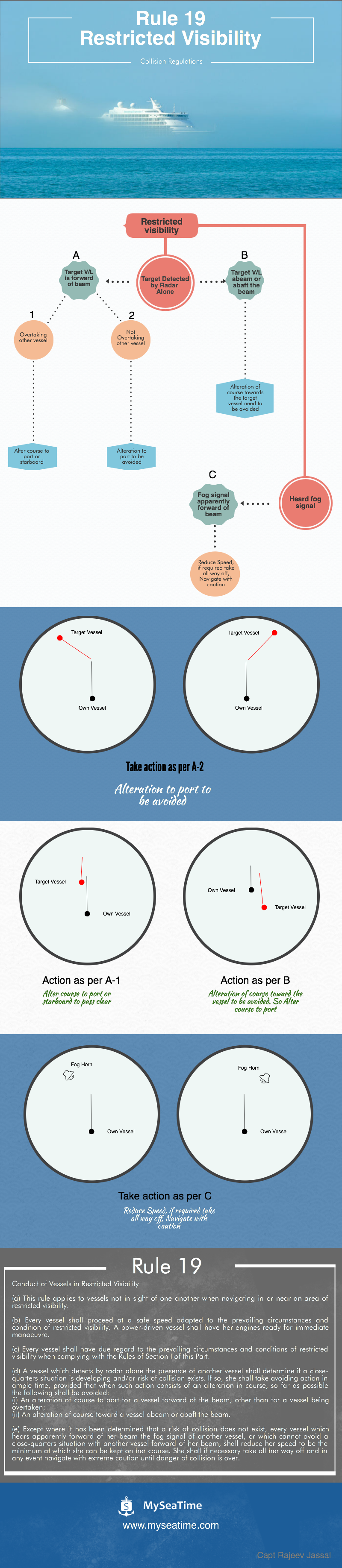
Infographic: Actions required in restricted visibility as per COLREG rule 19

39
Actions required in restricted visibility can be confusing. With this infographic, I try to simplify the action required in restricted visibility in form of a checklist. Restricted visibility
Join now to access this article and much more.

Admin has placed this article behind a paywall, making it accessible only with a paid membership, which offers numerous perks:

  • Contribute to creating a platform for reading and writing without ads.
  • Enjoy all content here, including exclusive articles for members.
  • Gain access to all exclusive articles for members.

Comments (39)

  • rakesh kumar July 2, 2016
    as per B target vessel is on our starboard quarter and we shouldn't alter our course towards the vessel abeam or abaft her beam...so according to me i should have altered my course to port to pass ...but u wrote alter course to starboard.....plz chk and conform
    1
    Rajeev Jassal July 2, 2016
    Thanks Rakesh for pointing this typo error. I have corrected it now..
  • Siva Chidhu July 4, 2016
    very nice article sir, as usual. Pls post regarding NArrow Channel & TSS also. And pls release blogs regarding Bulk carrier loading, stresses & problems in hatch covers. thank u sir
    3
    Rajeev Jassal July 5, 2016
    Happy to help Shiva.. Will try to post blogs for topics on bulk carrier..
    Mithilesh July 9, 2016
    narrow channel and tss is also bit confusing regarding actions to be taken by oow. sir, please if possible write abt rule no 9 & 10 .
  • Ankur Subhedar July 10, 2016
    RV. Target v/l right astern, ROC exist, action!!!
    1
    Rajeev Jassal July 10, 2016
    If you notice Ankur, overtaking situation in Rule 19 is somewhat like rule 13. It asks the vessel being overtaken to avoid alteration toward the other vessel. It does not tell us to take any action in particular. In the situation you mention, Unless we have communicated with other vessel, we need to keep our course and speed. Once the other vessel has altered her course to port or starboard we can alter our course in the opposite direction in opposite direction to increase the CPA if required.
  • Sagar Kumar July 14, 2016
    Well explained sir, request to write on other rules also sir.
    1
    Rajeev Jassal July 14, 2016
    Glad you liked it Sagar.. I will write on other rules shortly..
  • ankit vyas August 15, 2016
    very helpful article sir please post article on imdg usage on non container ship
    1
    Rajeev Jassal August 21, 2016
    Yes sure Ankit. I will write on that topic in future.
  • Shahnawaz Ansari November 19, 2016
    Sir can u pls tell me own vsl overtaking target vsl in fog in tss what action and how will you overtake
    3
    Rajeev Jassal November 19, 2016
    If there is restricted visibility, overtaking situation do not apply as rule 13 applies in sight of one another. So in this case we need to follow TSS as well as rule 19. As per rule 19 D (i) we can alter any side (port or starboard) to overtake.
    Shahnawaz Ansari November 19, 2016
    Sir apology but some one wants to know how to overtake in case of RV and HAVE to overtake.
  • Shahnawaz Ansari November 19, 2016
    In fog how will u determine if vsl is NUC pls requesting u to give some guidance on this
    2
    Rajeev Jassal November 19, 2016
    Rule 18 (which include NUC) applies in sight of one another. So NUC does not apply in restricted visibility. As per rule 19, there is no NUC vessel so we do not need to know if an vessel is NUC or not.
    Satyajit Dilip Vishwanathan August 21, 2019
    Fog signal for NUC/ RAM/ Fishing vessel/ CBD/ Towing Vsl Pushing ahead & Towing alongside is one prolonged blast followed by 2 short blasts. However it will not be easy to determine which type the vessel falls under. Also being in any one of the above class does not give any special privilege . In RV all vessel are give way vessels.
  • rahul raj March 12, 2017
    sir pls write article on the loran c
    1
    Rajeev Jassal March 13, 2017
    That is the equipment hardly seen on board these days.. But i will still try to cover that sometime..
  • manav March 30, 2017
    Sir kindly explain with reference to the photo which says action as per a1 .As you have a target on starboard quarter,nearly dead stern.why will you consider an optio to alter course to starboard as the rule says avoid altering towards a vessel abeam or forward of the beam.
    2
    manav March 30, 2017
    Correction:Sir kindly explain with reference to the photo which says action as per a1 .As you have a target on starboard quarter,nearly dead stern.why will you consider an option to alter course to starboard as the rule says avoid altering towards a vessel abeam or abaft the beam.
    rituraj chaudhary June 27, 2017
    if you check again, you will realise that the vessel you are talking about is our own vessel...so we are overtaking the other vessel..
  • sailesh April 30, 2017
    sir, which sound signal to apply when overtaking in restricted visibility?
    2
    Mark September 19, 2017
    One short blast to overtaking on your port side. Two to overtaking on your starboard side
    dave November 23, 2017
    No! None.
  • sailesh April 30, 2017
    can A Narrow channel be considered a Narrow TSS?
    0
  • sailesh April 30, 2017
    sir, in narrow channel is a Sailing vessel crossing you(power driven vessel) on your port bow. who has right of way? who is stand on vessel?
    0
  • nav December 2, 2017
    Dear Rajeev Jassal! Firstly, we all appreciate the time you spent on clarifying the matter. However, if you ask me, there is still one point to be worked out. As per rules it states ''...or which cannot avoid a close-quarters situation with another vessel forward of her beam, shall...''. The question suggests itself, how could I determine whether I can avoid close quarter or not purely by fog signal? I don't know neither course nor position of the signalling vessel. The part with reducing speed, bare steerageway and caution is a no-brainer. Same applies to the radar targets. But if I hear signal prior to detecting by radar, or prior to communicating with the approaching vessel via radiotelephony or... whatever means that make me able to establish the target's intentions, if only signal - first immediate action is slowing speed until I find out where is the other ship. And only then alter my course accordingly. But again... what is the reason behind this piece of rule ''or which cannot avoid a close-quarters situation with another vessel forward of her beam, shall..'' ? Would you be able please to elaborate on that? Thank you for reading this. Regards.
    1
    Satyajit Dilip Vishwanathan August 21, 2019
    First line of part (e) of the rules has the 2 following conditions Condition 1: You heard the fog signal of another vessel because you do not have an operational radar. As soon as it is apparent that the fog signal heard is forward of the vessel's own beam, you shall reduce speed and take all way off until the fog signal is no longer heard. Condition 2: " or cannot avoid a close quarters situation with another vessel forward of the beam". This part talks about a vessel which has an operational radar and has detected a target forward of the beam and because if she cannot avoid the ROC/CQS by alteration of course alone, than she has to reduce speed or take all way off. This part of the rule indirectly states that if there is a possibility to avoid ROC/CQS by increasing speed even though there is no other target in the vicinity and by the increase of speed alone the CQS/ROC can be cleared, then this is not allowed as by this part of the rule.
  • Yonela February 23, 2018
    Does rule 34 applies to restricted visibility?
    0
  • Shubham August 31, 2018
    In case of a vessel overtaking us from starboard quater as mentioned above we have to alter to port , how if there is fishing boat on the port side , then what to do , considering CPA with vessel on starboard quater is reducing ?
    0
  • ARCHIT GUPTA June 5, 2019
    What if fog signal heard abaft the beam , Rule 19(e) doesn't state what action to take in such circumstances .
    1
    Satyajit Dilip Vishwanathan August 21, 2019
    If fog signal is heard abaft the beam, it means that the vessel behind is overtaking and has come within the range in which we can hear the fog signal. Hence the best action would be to maintain course and speed. If the vessel behind us has an operational radar, then she will alter course to any side to over take us. If she does not have an operational radar then she will too will heard our fog signal and as per rule reduce speed till it no longer hears it. Rule also mentions that own vessel will navigate with extreme caution, meaning we can take additional actions like increasing the frequency of the fog signal to less than a minute and also turning the fog horn towards the aft direction to make it more audible to the overtaking vessel.
  • Vinay menon September 30, 2019
    Why mine clearance vessels lights are not same as ram lights even though it is one of ram vessels
    0
  • aditya rai November 26, 2019
    Sir can you please tell the difference between crossing situation in Tss between two power driven vessel in normal and restricted visibility.
    0
  • Anurag Gupta December 29, 2019
    Sir, which is better in restricted visibility : alteration of course or reduction of speed.
    0
  • Adi July 17, 2020
    sir,fog signal is coming abaft my port beam and increasing and my radar is also not working then best action for my vessel?
    0
Capt Rajeev Jassal

About Capt Rajeev Jassal

Capt. Rajeev Jassal has sailed for over 24 years mainly on crude oil, product and chemical tankers. He holds MBA in shipping & Logistics degree from London. He has done extensive research on quantitatively measuring Safety culture onboard and safety climate ashore which he believes is the most important element for safer shipping.

More like this

In blog, Marine Conventions

New Indian MS bill, DG shipping starts issuing SID and other stories of November 2016

Each month we bring only the main stories of the maritime field. These stories are carefully chosen to have only…

In blog, Ship Navigation

How to deal with Navigational warnings, A Complete guide

Most of the external agencies consider navigational deficiencies as most serious one. Not only because these can lead to accidents…

In blog, Ship Navigation

Here is All You Need to Know About Doppler Log

I am going to be brutally honest with you. To read about how Doppler log works is really a boring…

In blog, Ship Navigation

A step by step guide to ordering and correcting charts on ECDIS

Many believe ECDIS has changed the way we navigate our ships. Rightly so, after all we see our ship all…

In blog, Ship Navigation, Sight Basics

How a Marine Sextant Helps in Getting Ship Position ?

In the age of Google maps, GPS and AIS, there is something in the wheelhouse that looks so outdated. I am…

In blog, Ship Safety & Security

Safety Culture on ships: It is all about the trade-offs

A few years back, I did extensive research on “safety culture in shipping” as part of my project for higher…