
Get unlimited access to the best of MySeaTime for less than ₹100/week. Become a member

Members only

5 Confusing Terms of Ship Navigation and its Clarification

53
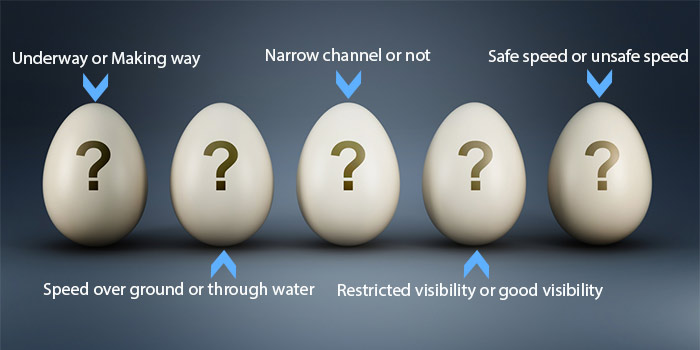
narrow-channel-restricted-visibility If it wasn't about safe navigation, no ship would reach its destination safely. But safe navigation is not only about steering a ship. It is also about navigators being crystal clear about rule of the roads and all the terms used in it. But not all the terms used in COLREGS are simple or easy to understand. For example while COLREGS has defined the responsibilities in a narrow channel, it fails to define narrow channel. If navigators do not know what is a narrow channel, how can they apply the rule ? There are many such confusing terms and I am here to discuss some of these. five-terms-about-ship-navigation Let is break these eggs to know the answers. 1. Underway or Making way These are simple terms but if we go in details of it, it might not look so simple. But what makes it important to differentiate between these two terms is the inclusion of these in COLREGS. For example, a vessel not under command is supposed to display different lights when underway and when making way. Also a vessel need to sound different sound signals when underway and when making way. S...
Join now to access this article and much more.

Admin has placed this article behind a paywall, making it accessible only with a paid membership, which offers numerous perks:

  • Contribute to creating a platform for reading and writing without ads.
  • Enjoy all content here, including exclusive articles for members.
  • Gain access to all exclusive articles for members.

Comments (53)

  • vijeesh kumar C September 26, 2016
    Thanks a lot sir....I asked the diff between underway and makingway in your articles...but no response was there...finally got it..u so much...would plz explain the meaning of close quarter situation too
    1
    Rajeev Jassal September 26, 2016
    Glad you liked it and I hope you got the answer for your question. Close quarter situation is a situation where a reasonable person would think that there is a risk of collision. This would depend upon factors like size of the vessel.
  • M.Saleh September 26, 2016
    Thanks,for clear explanation
    1
    Rajeev Jassal September 26, 2016
    Glad you liked it Saleh..
  • Capt Sunil Bhabha September 26, 2016
    Nicely written and explained in easy to understand language. Keep the good work on. All the best.
    1
    Rajeev Jassal September 26, 2016
    Thank you for your kind words Capt Bhabha..
  • Sudhanshu kumar September 26, 2016
    Thank you sir for such a good information and you explained well in easy terminology.
    1
    Rajeev Jassal September 27, 2016
    Glad you liked it Sudhanshu..
  • Pankaj September 26, 2016
    Well explained in easy words. Thanking you.
    1
    Rajeev Jassal September 27, 2016
    Thank you for reading Pankaj..
  • george fortomas September 27, 2016
    Small things are making the difference.Keep up the nice work sharing with us
    1
    Rajeev Jassal September 27, 2016
    Thank you for your kind words George...
  • Edward Watson September 27, 2016
    I'm not sure what is more worrying, the fact that the writer felt that there was need to write the article, or the fact that there appear to be so many people (navigators) who don't know this. We learned it on our first trip as Cadets, and it was subsequently drilled into us at college. A thorough working knowledge of the Collregs (with some common sense), tells one, all that one needs to know.
    4
    Rajeev Jassal September 28, 2016
    Hi Edward. I felt the need to write on these topics because I received lot of emails asking these questions. And I feel it is wrong for us to give an impression that the question is too obvious even if it was. But in these cases it wasn't. For example narrow channel looks too obvious but it isn't. Like this report shows how complicated these simple things actually are. In the case of collision between the vessels (incident that I mentioned in the blog) the Master was sentenced to 18 months in jail because he failed to keep to the starboard as he thought it is not a narrow channel (many experts believe he was right). So I humbly beg to differ from your opinion.
    Jack November 24, 2016
    Rajeev Jassal... thats a cool cool answer. Keep it up a good work. I admire your work and effort. I really like to read everything in your blog. Outstanding.
  • Rajeev Jassal September 29, 2016
    Hello Nitin, Any references that I use I link to them directly at the text (blue color text in the post). There is no reference that I took for the underway and making way section. The explanation is based upon the pure logic. For example As a navigator of a power driven vessel if I see a Not under command vessel, I would be interested in if NUC vessel can maintain its course or not. If it cannot, I would like to keep more CPA. This information I can get from what lights she is displaying. If the making way meant only that the "ship is moving" then I do not need to see the vessel's lights to know if she is making way or not, I can check that from my radar to see if she is making way or not. Can you tell what definition you have been reading about this. May be that is convincing enough to correct myself.
    0
  • Ali Ozcan October 4, 2016
    Clear explanation...thanx
    1
    Rajeev Jassal October 9, 2016
    Glad you liked it Ali..
  • Nitin October 5, 2016
    Sir i am convinced with your answer sir will be quoting the above answer to the surveyor , however, as far as restricted visibility is concerned , can we think of master's standing order and the details mention about the range of RV . Can we assume it to be the actual range at which the RV exist as mentioned in Master's standing order?
    1
    Rajeev Jassal October 9, 2016
    No Nitin.. Master's standing orders are his orders. As a Master I may want the OOW to inform me when viability is less than 6 mile but that will not be restricted visibility..
  • Deck cadet January 21, 2017
    Hi sir I'm getting so confused about a close quarters situation And different from risk of collision where expressed at rule 19 part d and e besides in collreg.thanks
    1
    Rajeev Jassal January 23, 2017
    Hi.. I did not get what you are confused about. Can you please ask a specific question and I will try my best to answer it. You can also ask your questions in SEAQA section.
  • JYOTI PRAKASH January 22, 2017
    Hi sir as you have rightly said that the definition of Making way through water is not mentioned in ROR. I have a little different opinion than you. In my opinion Making way through water simply means whether she has got any speed over water ie if her doppler log is showing some speed other than very close to zero over water she is making way; else she is underway and stopped. It has got nothing to do with steering capability. Consider a vessel which is doing 15 kts and her engine and Steering both fails so as per your opinion she shall be called NUC vessel Underway and not making way since she could not steer. NUV vessel has to show side light and astern light when it is making way. It is so because it should be apparent to the other vessel that it has got speed over water and other vessel should take action considering the fact that an NUC vessel is approaching ie she is doing some speed over water. And if an NUC is just showing two red all round light and non of her side lights and astern light it means that NUC vessel is stopped and she has no speed through water ie she is simply drifting. I request you to explain if my understanding is wrong.
    2
    Rajeev Jassal January 23, 2017
    Hi Jyoti, You have made some good points but as you said "speed very close to zero", can speed of 2 knots be considered very close to zero ? This is ambiguous. A ship can have Doppler speed of 2 knots while using the engine or even when she is drifting (when speed is affected by wind and not by current). When I see a NUC ship with 2 knots, I as navigator would not like to know if she is moving or not (this I can make out) but i want to know about her incapabilities. I am not saying the point you made is not valid, there is definately an ambiguity in "making way" and that is the reason its definition is not included in the Colregs. Colregs has left it to us.
    Prabh Dhillon May 16, 2017
    Good Day Sirs. I agree with Capt Rajiv Sir about definitions of making way. It's most accurate and closest possible. As well Jyoti sir's points about NUC vessels are also very sensible. But to contradict with it , I would put one point which will prove that a NUC vessel without Steering and engine and proceedings at 15 knots will be considered making way. Capt Saab have clearely mentioned that vsl shall able to alter her course to considered to be making way. 1)A NUC vessel in above situation can still steer using Emergency steering procedures i.e. using dragging weights - so she will be considered making way. 2)A NUC vessel will be considered underway if she can't alter her Course.
  • ANIKET GUPTA April 13, 2017
    First ,of all wud like to appreciate ur kind efforts for sharing ur thoughts.Further can u pls enlighten one of my doubts ......Ques) v/l dragging anchor ? underway or not, if underway then little explaination?.... considering it as an exceptional case even though she is touching the ground by virtue of its anchor it will be considered as underway only ,since at times anchor may be leaving sebed evn thou for a short period.(but i doubt my explaination)....................Ques) Difference between close quarter situation/risk of collision/impeding the safe passage??
    1
    Rajeev Jassal November 23, 2017
    Yes.. you are right about ship dragging anchor being underway. The 2nd question has been answered in SEAQA section . Check that out.
  • JISHNU May 6, 2017
    Very useful to mariners.
    1
    Rajeev Jassal November 23, 2017
    Glad to know that Jishnu...
  • Nishant Gautam November 23, 2017
    Many thanks sir !
    1
    Rajeev Jassal November 23, 2017
    Thanks Nishant...
  • Pat January 10, 2018
    Good professional inputs.... simple and clear.
    0
  • Satish Kumar March 25, 2018
    Thank u sir for sharing...Sir u have an article for 4stages of collision
    0
  • Utkarsh Kashyap May 18, 2018
    Dear sir, Can you please explain the difference between end-on and head-on??????
    0
  • Virendra Patel August 3, 2018
    Very nicely explained. Thanks a lot!
    0
  • Uday August 6, 2018
    How to identify the vessel not under command making way and vessel aground at when seen from stern ?
    1
    Harbinder Singh September 20, 2019
    @UDAY think of Rule 5 upto your maximum imagination
  • Harbinder Singh September 20, 2019
    @UDAY think of Rule 5 upto your maximum imagination
    0
  • Amar anand May 4, 2020
    Nice Blog sir
    0
  • avdhesh kumar May 23, 2020
    thank you sir, ur blogs are really great. it always helps me.. plz keep ur good work in continued way sir. we need you !! really appreciate it... thanks again.
    0
  • Wooden Ship Kits - Ages of Sail June 9, 2020
    That's really informative post. I appreciate your skills, Thanks for sharing.
    0
  • Gaurav August 13, 2020
    Good day all. Very interesting discussion here wrt making way & underway. I would simply put it as, any vessel which is making a headway should be considered as a vessel "making way" irrespective of the engines running and/ or the vessel being able to maintain its course. I say this simply because if we are to encounter a similar situation in RV and a vessel is stopped and underway and making no way thru water. Now how will you decide on blowing that TWO PROLONGED BLASTS. If your vessel is making headway at a speed of 1 knot and is unable to steer due to lack of speed what would you do? As per all the explanations above this is a case of vessel being underway and therefore you will sound TWO PROLONGED BLASTS. I am afraid I respect your point of view but i beg to differ. I would, as a prudent Master sound ONE PROLONGED BLAST to ensure that the vessels in the vicinity get the correct picture that I am still moving at a speed of 1 knot in some direction. And that will confirmed by the vessel observing me in her RADAR screen too and there is no ambiguity as to weather the vessel showing on radar screen is showing a speed of 1 knot where as the sound signal being heard is of a vessel being stopped. BEFORE WE GIVE OUT THIS TWO PROLONGED BLASTS WE MUST FULLY ENSURE THAT WE ARE NOT MAKING WAY AND ARE COMPLETELY STOPPED AND JUST UNDERWAY. Many may not agree with me but there are instances where the judges have held this view that any vessel making any kind of headway cannot be considered as a vessel underway and not making way. I think the rules are pretty clear with regards to underway and making way. Its just that we need to get a very good grip on understanding the same considering all the aspects at the same time. This can get really confusing at times. Best regards.
    0
  • Ankur Dwivedi February 8, 2021
    Thanks a lot for these important points of colreg.
    0
  • Sanjay February 28, 2021
    Thanks Sir for giving your great time..
    0
  • Jordangill May 3, 2021
    Hello rajeev sir, you just rock it. Thanks for this guide. I am from minnesota and i frequently read your article, I have one power boat and i generally move it using Citizenshipper haulers in minnesota. https://citizenshipper.com/boat-transportation/minnesota.
    0
  • Alexform May 3, 2021
    hello
    0
  • Value Market Research July 17, 2021
    According to Value Market Research, the latest technology trends and global market opportunity analysis in the Marine Engines Market industry growing with a high CAGR in the upcoming year. Our report has categorized the market based on technology, service, development, vertical and region. https://www.valuemarketresearch.com/report/marine-engines-market
    0
  • Value Market Research August 31, 2021
    According to Value Market Research, the latest technology trends and global market opportunity analysis in the Flight Navigation System Market industry growing with a high CAGR in the upcoming year. Our report has categorized the market based on technology, service, development, vertical and region. https://www.valuemarketresearch.com/report/flight-navigation-system-market
    0
  • mycarremoval October 25, 2021
    I am really happy to say it’s an interesting post to read . I learn new information from your article , you are doing a great job . Keep it up
    0
  • UPD Plastics February 4, 2022
    Great information! Thank you for sharing with us. Keep sharing...
    0
  • Guilherme Pereira February 17, 2022
    Congratulations about the post! I would like to include to this distinct list the word "UKC". We all know that "UKC" comes from "Gross Underkeel Clearence" or "Gross UKC" or as usual the simplest and very known "UKC". ...Never forgeting that there is the "Net UKC" that is mentioned in the academic literature as a safety margin, that is one of the factors related to the ship, which PIANC experts call as "Design Water Level " You shoul know that some portuguese spokers make intentionally or non intentionally a very strange translation of these words, that confuse even experts. For instance, this could lead a very dangerous safety of navigation issue. Please take that into consideration, when navigation at South American territorial waters!
    0
Capt Rajeev Jassal

About Capt Rajeev Jassal

Capt. Rajeev Jassal has sailed for over 24 years mainly on crude oil, product and chemical tankers. He holds MBA in shipping & Logistics degree from London. He has done extensive research on quantitatively measuring Safety culture onboard and safety climate ashore which he believes is the most important element for safer shipping.

More like this

In blog, Ship Navigation

20 Navtex Question (and answers) to Make Naxtex Your Friend For Life

Do you struggle to sort out navtex warnings ? If yes, you are not alone. Many believe that Navtex is not…

In blog, Cargo Operation, Maritime Law, Shipping Business

A Layman’s Guide to Laytime, Charter party Agreement and Voyage Charter

The word “Charterer” is probably as old as the word “Ship” itself. Do you keep hearing this word so regularly?…

In blog, Marine Conventions

Infographic: A Comparison Between Hague Rules and Hague Visby Rules

Hague rules brought a balance between shipper-carrier agreement. Before these rules the contract of carriage used to be in favour…

In blog, Marine Conventions, Ship Safety & Security

Ensuring compliance with ENOA/D for vessel trading in US waters

ENOA/D stands for “electronic Notice of arrival and Departure”. Both US coast guard (USCG) and “Custom & boarder protection (CBP)”…

In blog, Ship Navigation

How to know if the anchor is dragging ?

Provided the ship has enough provision, water and fuel, everybody loves time at Anchorage. Right? We all love having the…

In blog, Ship Safety & Security

What is Risk Assessment and Why it is so Useful On Board ?

Many believe risk assessment is quite boring subject and has nothing to do with reality on board ships. Some also…