Get unlimited access to the best of MySeaTime for less than ₹100/week. Become a member

Members only

5 Loadicator tricks that can ease your life during cargo operation

46
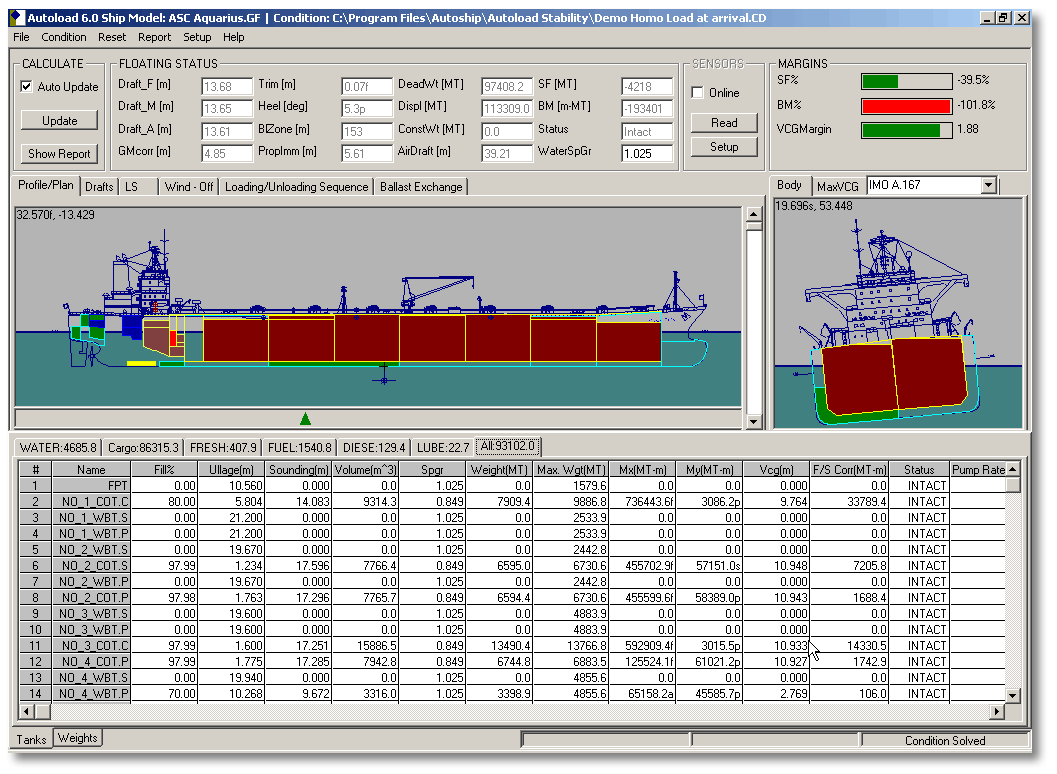
Autoload Tanker loading computer screen Have you ever imagined our life on board without loadicator? While some intellectuals might find it of no difference to live without it, most of us can imagine how difficult it will be to calculate trims, drafts etc manually. And most difficult part (rather an impossible one) will be to calculate Shear forces (SF) & bending moments (BM) manually. So while most of us agree that loadicator has made our life onboard (Definitely the chief officer’s)  simple, are we using our loadictor to only calculate drafts, trims and stability? There are many other things that we can use loadicator for. This post will highlight at least five of these things you can do with loadicator. But before you do anything with loadicator, it is important to ensure that loadicator complies with the testing and carriage requirements. Assuming your loadicator complies with all requirements, Let us take a recap of what we generally do with Loadicator. Usual things everyone does on Loadicator The first thing we do on receiving the voyage instructions is planning the stowage. And the first thing we keep our eyes on while planning the stowage on loadicator is trim and list. Loadicator provides information on the trim and list that the vessel will have in a particular stage of the stowage. Othe...

Join now to access this article and much more.

Admin has placed this article behind a paywall, making it accessible only with a paid membership, which offers numerous perks:

  • Contribute to creating a platform for reading and writing without ads.
  • Enjoy all content here, including exclusive articles for members.
  • Gain access to all exclusive articles for members.

Comments (46)

  • concerned sailor March 11, 2016
    Capt Rajeev, very nicely written article. most officers/crew on ship are well aware of their jobs. their professional competency is usually good. where we fail is in utilizing the most important asset given to us, which is the crew. man management & soft skills are the most important quality a management level officer has to have. we are all aware that many indian seafarers do not want to sail with an indian master for reasons as flimsy as "poor food" or "too much interference in work" etc etc. we need to do something to to change our image. master sometimes is unable to handle his subordinates and he threatens them by spoiling their appraisal etc. we need to have a broader outlook on things while handling people on ship. would end by requesting to pls post an article on man management successfully at sea! Best regards.
    1
    Rajeev Jassal April 24, 2016
    During our sailing career, we get to sail with different kind of people. We should make it a point to only draw positives from everyone. And sure there is something positive in everyone. Thanks for suggesting a topic for writing..
  • A khan May 6, 2016
    Thx lot sir...could you tell sir..testing procedure of loadicator. Regards
    1
    Rajeev Jassal May 7, 2016
    Please go to this link. http://www.myseatime.com/blog/detail/compliance-with-loadicator-testing-and-its-records I hope this is what you are looking for. If you have any other question please let me know.
  • Rahul Dutt June 12, 2016
    Good Day Sir, I am appearing fr mates orals if u can please share your knowledge on how to calculate SF and BM if the loadicator fails and on criteria are limits of SF and BM based. Thanking yoy in advance
    1
    Rajeev Jassal July 16, 2016
    There is no practical way that we can calculate SF & BM onboard ships. We learn to calculate SF & BM for a box shaped vessel to get an understanding of how SF and BM are calculated. But the manual calculation of SF & BM for an actual vessel is very very difficult if not impossible. We need a software (Loadicator) to calculate that.
  • Vijay Pandey July 17, 2016
    Dear sir, This article is more about loadicator tricks which are applicable to tankers, kindly advise the tricks which are applicable to bulk carriers.
    1
    Rajeev Jassal July 18, 2016
    I will try to post that Vijay but I need to either get my hands on bulk carrier loadicator or find somebody to write for bulk carrier which we are trying..
  • ARVIND August 21, 2016
    Rajeev sir..good day..Had querry regarding loading of heavy lift ..i understand this question is different from Tanker part..Can i load a heavy lift of 200tons on area of 1x2 m2 on surface of load density 100 tons..means same as load density..if yes then why/if no then why?kindly explain..
    3
    Rajeev Jassal August 22, 2016
    Hello Arvind, I assume load density is 100 T/m2. This means that in 1 m2 area it is allowed to load 100 tons. Based on that on 2m2 area we can load 200 tons of cargo provided that weight of the heavy lift is evenly distributed and the base of the heavy lift is of 2m2. This means that we can load 200 T of box shaped weight with surface area of 2m2. When we calculate the area we take the surface area of the weight and not the surface area of the available space.
    Arvind August 28, 2016
    Rajeev sir..thanx again..do we consider the stress for lashing the heavy weight on tanktop which might exceed more than 100t/m2..if we tighten the lashing ..
  • Lee August 24, 2016
    Sir, thank you for thr blog its very informative. Please if you can write topic of how chief mates update there loadicator at sea. Where did the get there figures like fuels consumed and others and how they get arrival conditions. I have sailed with mates where when sailing from ports can provide sailing condition and arrival condition of next port which is 2 weeks voyage thank very much
    1
    Rajeev Jassal August 25, 2016
    Lee, the figures for fuel consumed for calculating the arrival condition of future ports are estimates which chief mate gets either from the chief engineer or he can calculate basis number of days and fuel consumed per day..
  • Gaurav bahuguna September 8, 2016
    Good day sir ,I am appearing for my 2nd mate orals and I wanted to know how to correct the angle of heel if the ship is at sea and what are the stresses the ship undergo. Thanks
    1
    Rajeev Jassal September 8, 2016
    The best way to correct heel is by ballasting. But if the vessel is loaded to the maximum and ballasting is not an option then we can consume the bunkers in a way to correct the list. Or we can also transfer the bunkers.
  • MRG October 4, 2016
    Rajeev is correct. Vessels have Stability documents/loading manual that would give the method and values for manual calculations. This is involved and very interesting. There are worked example(s), and you can master this by calculating say 3 times. It requires a bit of focus and "can do" attitude. For oral examination you may refer to the documents above, and respond as above. If possible examine a loading manual. Cheers, MRG from Vancouver.
    1
    Rajeev Jassal October 9, 2016
    Thanks MRG for contributing your views..
  • Lee October 12, 2016
    Sir, please can you write about loadicator longitudinal strength curve. SF and BM in loadicator. What to look at and what those curves mean and what to avoid. Thank you very much for your time.
    1
    Rajeev Jassal March 13, 2017
    At any time during loading, unloading and voyage the actual SF and BM should be less than 100% of the allowed limit.
  • sharath prasad October 21, 2016
    hello sir. can you please explain to me if and why the loadicator has maximum permissible stress limits in harbour and at sea and also why the sea going condition has more strict requirements than the harbour condition ?
    1
    Rajeev Jassal March 13, 2017
    That is because in harbour there are minimum external forces acting on the ship. Where as at sea the ship may be subjected to extreme wx conditions..
  • PAWAN November 18, 2016
    IN LOADICATGOR what all parameter changes with change of density ?
    0
  • Suraj March 12, 2017
    sir why loadicator has harbour as well as sea condition.?
    1
    Rajeev Jassal March 13, 2017
    As in harbour condition, there are minimum external forces acting on the ship, ship is allowed to have more stresses while in harbour (for example during intermediate stages of cargo operation).
  • nandkishore gitte April 24, 2017
    Nice and in detail article .....help full for engineers to who are preparing for there COC
    1
    Rajeev Jassal April 30, 2017
    Thanks Nand Kishore..
  • Anthony December 19, 2017
    Good day Sir, Iam using MECCA loadcom onboard, but the function for calculating constants doesnot show . could you kindly elaborate how to calculate the constants on Mecca loadicator, as you have also shown screen shots of Mecca in your blog.
    0
  • siddharth gaur December 27, 2017
    Hi Sir can you please tell what is the affect of trim on a gz curve .
    0
  • Kynan Noronha January 20, 2018
    Good Day Capt Rajeev Just a small query .Wanted to know what is the general allowed limit for SF & BM for tankers.And from which document can we find this mentioned limit . Thank You
    0
  • aeplglobe May 29, 2018
    Thanks for sharing it href=” https://www.aeplglobe.com /safety-relief-valves/”Leading LPG Vaporizer Manufacturers in India”
    0
  • najma qureshi July 30, 2018
    Great content. I would like to add on that it all depends on the calculation that is done for an efficient work system. Thanks for sharing.
    0
  • VIKRAMJIT SINGH August 7, 2018
    Dear Sir, Please explain the difference between sea and harbour conditions of loadicator.
    0
  • Sajjad Modak September 14, 2018
    Thanks Sir for the important topics you are covering in your blog. It take lot of patience & hardwork indeed. Your blog is an digest for new comers & for those who are already in sea service for years. As mentioned in comment above by concerned sailor , we readers would be thankful to have your views on mentioned topic. Also how MLC helps an seafarer when ashore i.e employer refusing to hire an seafarer for not signing appraisal report by Master etc Thanks & Regards S M Modak
    0
  • Giorgi Giorgi December 8, 2018
    Capt Rajeev, thanks for very nicely written article. Can you please write article regarding ASTM PM Table including use of table 6A ,6B , 54A ,54B , 24A , 24B and case when we need to use function USER DEFINE
    0
  • Antriksh Walia May 18, 2019
    Dear Sir, I'm working on coastal cargo vessels less than 100m length without a lodicator how can I calculate SF and BM stresses on ship during various loading conditions. Kindly advise...
    0
  • Vivek Marol July 19, 2019
    Sir, ....Sea Condition....what's the reference value for this condition for a particular ship in its loadicatir
    0
  • an November 20, 2019
    How to load a tanker if loadicator stopped working ??
    0
  • Ahmed Alwan February 6, 2020
    Dear Sir, Appreciate if you help me to understand fully the difference between Sea and Harbor conditions and during anchorage for example winch condition better to use? for LNG gas tankers, when we will get the maximum bending moment BM ? in which stage of loading? and the location of the BM? During loading , is the ship hogging or sagging and why?
    0
  • AMAR ANAND April 26, 2020
    Amazing article sir....
    0
  • Alok Kumar August 3, 2020
    Sir how much maximum SF, BM and TM is allowed. Officially. Which will not be any problem with any authority.
    0
  • Phan Hung Tan May 26, 2021
    Dear Capt,can you help for test loading condition of the loadicator system by quarterly by ship staff
    1
    Hieu Le September 1, 2021
    https://www.myseatime.com/blog/detail/compliance-with-loadicator-testing-and-its-records. you refer this link
  • Pratik June 3, 2021
    Thanks for the above info. Sir, Can you please help me out in finding what is the difference in calculation procedure of SF & BM ( what parameters are changed) while in Sea- going conditions & while in Harbour condition ?
    0
  • joham william January 17, 2022
    FIX THESE 6 COMMON COMPUTER PROBLEMS EFFICIENTLY
    0
  • Anish May 19, 2022
    Can you please post how to do damage stability calculations on a Loadicator?
    0
Capt Rajeev Jassal

About Capt Rajeev Jassal

Capt. Rajeev Jassal has sailed for over 24 years mainly on crude oil, product and chemical tankers. He holds MBA in shipping & Logistics degree from London. He has done extensive research on quantitatively measuring Safety culture onboard and safety climate ashore which he believes is the most important element for safer shipping.

More like this

In blog, Ship Navigation

How to Handle Distress Messages Received on GMDSS

The strongest people make time to help others, even if they are struggling with their own personal demons. This saying is so…

In blog, Maritime Law

Incoterms: Guide of everything you want to know about

Incoterms is the short form for International Commercial terms. These terms relates to the sales contract and are used worldwide.…

In blog, Marine Conventions, Ship Safety & Security

Continuous Synopsis Record (CSR) : What It Is And How To Ensure Compliance ?

  If I ask you, who is the registered owner of your ship, will you be able to get this…

In blog, Marine Conventions, Ship Safety & Security

Why it is so Important to Know About Statutory and Mandatory Certificates ?

A ship without certificates is a dead ship. It is impossible to sail a ship in high seas without valid…

In blog, Ship Safety & Security

A comprehensive guide of fixed fire fighting foam system

Let me narrate you a real story. A ship was to arrive in a US port after a long sailing. Foam…

In blog, Ship Navigation

Marine radar: How best to set up to have it plot perfect targets on screen

Radars on board are probably the most used equipment during navigation. It is a good tool for the look out. We…