Get unlimited access to the best of MySeaTime for less than ₹100/week. Become a member

Members only

Speed Through water or speed over ground, Which one to use ?

245
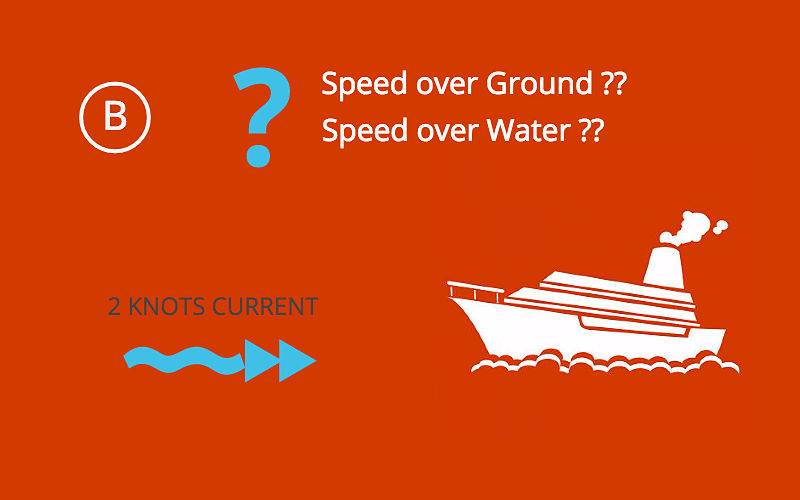
When it comes to speed over water vs Speed over ground, many of us get confused. May be, it is a confusing topic. What do you feel ? And the confusion is not only what is the difference but also where and when these are used ? Why we need to have input of speed over water in radar ? Why do we have doppler log on board ? And many more questions like these. Speed over water and speed over ground So today i want to put all these doubt and confusions to rest once for all.  But before i start, I need you to ask yourself this question. Do you know the answers of questions I asked above ? Let’s test it. Can you tell what is the speed over ground and speed over water in these three conditions ? Condition A: No wind, no current, absolute ideal conditions. The GPS speed of the ship is 15 Knots. Speed over water Condition B: All other conditions being same but now we have 2 knots current from ahead. What will be speed over water and over ground in this case ? Speed over water situation B Condition C: All other condition...

Join now to access this article and much more.

Admin has placed this article behind a paywall, making it accessible only with a paid membership, which offers numerous perks:

  • Contribute to creating a platform for reading and writing without ads.
  • Enjoy all content here, including exclusive articles for members.
  • Gain access to all exclusive articles for members.

Comments (245)

  • Amit April 2, 2016
    Very good explanation , only a guy whose been there can highlight the concerns of a mariner in -charge.Simple explanation.....great effort!!!!!
    9
    Rajeev Jassal April 22, 2016
    Glad to hear that Amit... Keep me posted on any other topic you want me to write about..
    nic December 23, 2016
    so speed over water is not affected by current????
  • Mradul April 3, 2016
    Very good explanation about SOG n STW. Very informative sir.... !!! This is the 2nd blog i hv read from u sir.. last one being on ECDIS.. thnx.. awaiting many more such blogs frm u !!!!!...
    4
    Rajeev Jassal April 22, 2016
    Thanks for reading Mradul... And yes many more blogs will be coming your way..keep reading
    Sourav Chhapola July 24, 2016
    Thank you sir, it was very informative and was in simple explanation
  • king April 4, 2016
    v.good and thanks
    0
  • king April 4, 2016
    v.good and thanks
    5
    Rajeev Jassal April 22, 2016
    Glad you liked it king
    Taranand April 27, 2017
    Sir i wanted to know, even if ship is stationary the log will show some speed and log gives speed through water,!
  • Karthick May 26, 2016
    Really excellent sir. after being three years at sea,im well clear now. thank u soo much. great effor. keep posting more.
    1
    Rajeev Jassal May 26, 2016
    Happy that it helped you Karthick. Let me know if I can be of any help anytime.
  • Rajeev Jassal May 30, 2016
    Glad you liked it AJAY.. Thanks for suggesting a topic, I will write on that near future.
    1
    Gilson July 24, 2016
    Hi, thanks for the explanation, it was very helpful. I would like to know if this blog is still working, Could not find new tops on it. Thx!!
  • Gautam Dogra June 6, 2016
    An infomative article in a very simple and lucid manner.Thankyou very much captain.Hope to get more fantastic surprises like this from you.Shiva bless you
    1
    Rajeev Jassal June 6, 2016
    Happy that you like it Gautam..
  • Rohan June 6, 2016
    Great explanation in an simplest way possible! Really appreciate your efforts
    1
    Rajeev Jassal June 6, 2016
    Happy to help Rohan.. Let me know if I can be of any other help anytime
  • Abinash June 6, 2016
    Nice n simple explanation.....looking forward for use of Parallel indexing... And sir kindly reply in mail if possible
    1
    Rajeev Jassal June 8, 2016
    Glad you found it useful Abinash..Sorry but I didn't receive any email. You can contact me Through contact section in the top menu..
  • Druvil June 11, 2016
    1: In all my life I never heard before of speed OVER water? did you mean speed THROUGH the water, Sir? 2: in the examples you made, you talk of GPS speed reading. Well, according to the majority of seafarers out there, the GPS will give you ALWAYS a SOG and not a STW, which is instead what the Log will give you..... Just those 2 things let me realize I lost 10 minutes of my life reading this "article". Regards.
    0
  • Rajeev Jassal June 11, 2016
    Speed over water and speed through water are one and the same thing and I have heard both terms being used by many people. I am sorry to have you given an impression that GPS speed is speed though water but I am not sure why you got that impression as I referred GPS as speed over ground.
    0
  • Henry July 5, 2016
    Hello Captain, thank you for your lesson which i can't even get in my institute. I have a question by the way. For the collision example, if i observe visually when 2 ships are in sight, there will be a crossing situation right?
    2
    Rajeev Jassal July 5, 2016
    No Henry.. if you are on one of the ship and when you observe other vessel, you will be able to see the vessel head on with both masthead lights in line.. Both the ships will be facing head on but will be moving in the line of their course made good. Hope that clarifies
    Real Estate January 21, 2022
    Thanks for providing the very good tricks to us.It is very useful for getting results in SERP. real estate agency, real estate agent
  • Christin July 9, 2016
    Officers get easily confused when port state comes with such questions.. Hope you will post more of these stuff. And the figurative explanations are much more understandable than plain notes on these..
    2
    Rajeev Jassal July 12, 2016
    Happy that you liked it Christin.. I will be posting more of these in near future.. Thanks for reading.
    Real Estate January 21, 2022
    Thanks for providing the very good tricks to us.It is very useful for getting results in SERP. real estate agency, real estate agent
  • mithilesh July 9, 2016
    awesome blog sir....it washed away my lots of confusions....u have explained it in such a easy language..which made it so easy to understand...
    1
    Rajeev Jassal July 12, 2016
    Glad that I could be of some help to you Mithilesh..
  • TAUFIQ S BHOMBAL July 11, 2016
    Dear sir,thank u for an easy n much useful explanation.Very well n clearly explained.Hats off to u.
    1
    Rajeev Jassal July 12, 2016
    Glad that you found it useful Taufiq..
  • jino job July 14, 2016
    Sir I have asked many people about the same qustion but I ddnt get a good ans.. after reading this my all doubts cleared. Thanks sir
    1
    Rajeev Jassal July 14, 2016
    Glad that it could clear some of your doubts Jino. Let me know if you have any question anytime..
  • Vivek kothambath July 14, 2016
    Thank you sir for nice explanation
    1
    Rajeev Jassal July 14, 2016
    Glad you liked it Vivek...
  • Utkarsh July 14, 2016
    This article is so good! Great great refreshment for memory! Thanks a ton cap!
    1
    Rajeev Jassal July 14, 2016
    Happy that you liked it Utkarsh..
  • Aditya shankar chakraborty July 14, 2016
    Very practical explanation wd more relevent examples.....thank you sir.....its very helpful:):)
    1
    Rajeev Jassal July 15, 2016
    Glad you found it helpful Aditya..
  • Vincent D'Mello July 14, 2016
    Excellent explanation.
    1
    Rajeev Jassal July 15, 2016
    Thanks Vincent...
  • Clinton July 15, 2016
    An excellent & simple explanation. Very well written & illustrated.
    1
    Rajeev Jassal July 15, 2016
    Glad you liked it Clinton..
  • Gurpreet July 15, 2016
    I am sure, all of us are heading for a better future of mariners. Thank u for your efforts.
    3
    Rajeev Jassal July 15, 2016
    Together we will make sure better future of Mariners Gurpreet..
    cecilio rahon Jr July 15, 2016
    Thanks for the post. May I share it?
  • abin Robert July 15, 2016
    I smell a subramaniam in you, Great explanation. I never going to confuse this now onwards
    1
    Rajeev Jassal July 16, 2016
    Thanks Abin for your kind words.. Glad it could be of some help to you..
  • Levon July 15, 2016
    Thanks Capt.
    1
    Rajeev Jassal July 16, 2016
    Thanks for reading Levon..
  • Jitendra July 23, 2016
    sir very useful, great explanation and explaining abilty. you make coplicated topics to understand very easily.
    1
    Rajeev Jassal July 24, 2016
    Thank you Jitendra.. Happy that you found it useful..
  • Abdul August 11, 2016
    Thanks Sir for such a simple explanation.Sir,can you please tell me what is the difference between Log Speed and Observed Speed.How do we determine these two.Also which one of these are to be considered for calculating the fuel consumption or the Power.Thanks in advance.
    1
    Rajeev Jassal August 21, 2016
    The power and fuel consumption is not calculated by the the speed. Log speed is the speed made through water and observed speed we refer to the distance made between point A and B. Observed speed could be different from GPS speed because we might have done few alterations to avoid traffic and would not have proceeded directly from point A to point B. So observed speed is the effective speed made by the vessel.
  • cLivanz August 17, 2016
    i like your blog Mr. Rajeev indeed its helpful. Id like to ask you something, about T&P for Jeppesen C-map, it seems it doesn't show the visualization of T&P unless you have list of T&P from NTM.
    1
    Rajeev Jassal August 21, 2016
    Yes, Infact T&Ps through AIO only shows the affected area and T&P number which user need to view the information by going to the properties. UKHO is trying hard to come out with a better way to display T&Ps. Till that time we have to live with it. It would be a good practice to keep the print outs of the T&Ps affecting voyage ENCs and keep near the ECDIS for the watch keepers to refer quickly.
  • Vijeesh kumar August 23, 2016
    Thanks a lot......u did a great job...dont know...how to thank you...please tell me diff btwn underway and making way....waiting eagerly for more interesting stuffs from your blog
    1
    Rajeev Jassal September 15, 2016
    Underway is when ship is afloat but not at anchor or at berth and not using engine. Making way is when vessel is making way through water and using engines.
  • NICOLAS September 14, 2016
    Hello, can clear a doubt for me ?, when we speak about SOG and we need instant SOG, for example in anchoring, which source is best, GPS or doppler speed log ? I think Doppler speed log is best for being instantaneous, and GPS needs to compare between 2 positions and maybe one of them is not so good to be consider for this purpose....Am I right ? thanks a lot
    5
    Rajeev Jassal September 15, 2016
    Nicolas.. Doppler does not give SOG. Doppler gives speed through water. Also GPS speed is good and accurate and we can use it during anchoring also.
    NICOLAS September 15, 2016
    Excuse me Sir but you can select in some doppler speed logs STW or SOG, obviously when sea bottom is available, next is an extract for a manufacter brochure : " The Doppler speed log measures a vessel's speed through the water or over the seabed ". I personally remembered this function onboard. Thanks anyway, very good article
  • sushant singh rawat September 20, 2016
    Superb explanation, was never so easy to learn. kindly comment on underway and making way.Thanks
    1
    Rajeev Jassal September 22, 2016
    Glad you liked it Shushant. Next post in line will discuss the difference between underway and making way.. Hope you will find that helpful.
  • Prabhath Mathew September 20, 2016
    Amazing explanation sir. Will ARPA calculate different CPA for SOG and STW ? Which will be the accurate CPA ?
    1
    Rajeev Jassal September 22, 2016
    ARPA will show same CPA and TCPA with both the speeds. Both will show exactly same CPA & TCPA
  • saba karim September 24, 2016
    Awesomeee explanation sir..... Now my doubt abt sog and sow is totally cleared. Thnxs for sharing such wonderful information sir.
    1
    Rajeev Jassal September 26, 2016
    Glad you found it useful Saba..
  • Gulbag Singh September 25, 2016
    Thanks capt for taking the pain to gain us
    1
    Rajeev Jassal September 26, 2016
    Happy to help Gulbag..
  • Capt.Dr. russtam Mohammed Ismail September 27, 2016
    Very good job! thanks
    1
    Rajeev Jassal September 29, 2016
    Thank you so much for your kind words Sir..
  • Fritz Gerald Roco October 7, 2016
    Good Day Sir! I would like to ask some question regarding this matter. You made a real good point in using the speed over water to determine the situation of both vessel if it is crossing or head on situation which is right. Now that you have determine the situation and apply the maneuver should you maintain using SOW or should you use SOG?
    1
    Rajeev Jassal October 9, 2016
    Once you know the situation, all you want to know is CPA & TCPA. Both speeds will give same CPA/TCPA so it does not matter which speed you use for that.
  • Hector Prado November 7, 2016
    Awesomeee explanation sir. But I still have a doubt about how an instant STW measured by doppler log is affected by a current from ahead. If the vessel's speed is 10kn and the current from ahead is 2kn, the speed (if no current) would be 12kn? And the SOG would be same 12kn?
    1
    Rajeev Jassal November 9, 2016
    Hector, the doppler speed is not affected by the current. It does not matter how much the current is, doppler speed (STW) will be same because of its principle of operation.
  • Aditya November 7, 2016
    I think the three cases you illustrate give an impression that the GPS always measured 15kn, which happens to be speed over water in those examples.
    0
  • Aditya November 7, 2016
    Just to clarify, since you do not explicitly state GPS speeds in cases B and C, that probably gave the impression of GPS measuring speed over water. I think you may clarify that speed over water in all cases remains constant, and then ask what GPS reading will be. That will be clearer in my opinion. It will illustrate more clearly how speed over ground is affected by currents given constant speed over water.
    0
  • Rajeev Jassal November 7, 2016
    Thanks Aditya.. That may have caused the confusion for Druvil but I think most of the reader (including yourself) got it that GPS speed was mentioned just for the reference in the first example. I will think over it again how i can remove this confusion. Thanks once again for suggesting this..
    0
  • Harmanpreet November 9, 2016
    Thank you very much sir, long time I had been seeking the suitable explanation on this important topic. Really very helpful.
    1
    Rajeev Jassal November 9, 2016
    Glad you found it useful Harmanpreet..
  • Jack November 9, 2016
    This is the best explanation of STW and SOG that all Masters, Officers and Cadets should read. Appreciate your effort and time on this writing.
    1
    Rajeev Jassal November 9, 2016
    Thank you for your kind words Jack..
  • Kadali November 13, 2016
    Capt.Sab this is the 2nd blog I have read, the explanation with examples made interesting,really very practical approach in explaining keeping in mind all ranks. Very clear on Sog and sow.
    1
    Rajeev Jassal November 17, 2016
    Thanks Kadali..
  • Psingh November 29, 2016
    a doubt: Does anywhere in RoR or as per IMO is given to use STW for coll avoidance? also how to explain that RoR is based on aspect? like heading of the vsl? thanks in advance
    1
    Rajeev Jassal November 29, 2016
    No.. It is not mentioned in RoR that speed through water to be used for collision avoidance. But it is rightly implied so by oil majors and by the industry experts. This is the main reason why we have feed of speed log in RADARS. During SIRE inspections on tankers, it is checked by the inspector if the ships are using STW. ROR is based on aspect because all the definitions of situation like Head on and overtaking etc are as per the aspect of the vessels and not how the two vessel are moving.
  • Swapnil December 4, 2016
    Superb explanation sir. It's very easy to understand and gives thorough understanding of the subject.
    1
    Rajeev Jassal December 4, 2016
    Glad you found it useful Swapnil..
  • Andy December 6, 2016
    I found very useful of your blog. i still have i more questions, what meant by sea stabilized and ground stabilized in radar setting? Thank you so much.
    1
    Rajeev Jassal December 6, 2016
    Glad you found it useful Andy. Sea stabilised Radar is when we use log speed (speed through water) in the radar. Ground stabilised Radar is when we use GPS speed (speed over ground) in the radar.
  • Angie December 8, 2016
    Hi sir, so can I just safely say that STW is equal to engine speed based on the RPM given?
    1
    Rajeev Jassal January 29, 2017
    In ideal condition..Yes but the difference will be if any speed reduction due to foul hull or due to high wind.
  • Rigel CHEUNG January 2, 2017
    Somethings in doubt, my ship's doppler logs have a 'bottom lock' function when UKC is less, it means the doppler log will not provide STW to APRA, If APRA are setting to true motion radar display, what problem will come out ?
    1
    Rajeev Jassal March 13, 2017
    In this case as the ARPA will have SOG, even if the radar is set to true motion, the targets will be shown moving along their course made good. We still will not have the aspect of the vessel on radar on which ROR is based.
  • Ian Kirby January 2, 2017
    You're very thorough sir. Excellent interpretation. Very uselful
    1
    Rajeev Jassal January 29, 2017
    Glad you found it useful Ian..
  • NIVAS January 29, 2017
    GREAT EXPLANATION SIR, SINCERELY APPRECIATE YOUR EFFORT FOR FELLOW MARINERS!!
    1
    Rajeev Jassal January 29, 2017
    Thanks Nivas..
  • Rajesh Sharma February 20, 2017
    Very good explanation
    1
    Rajeev Jassal February 25, 2017
    Thanks Rajesh..
  • Vasyl Plotny February 26, 2017
    Very informative article, all laid out on shelves and extremely affordable explanation. Thank you!!!!
    1
    Rajeev Jassal February 26, 2017
    Thanks Vasyl...
  • Nirmal February 28, 2017
    Sir,i dont know you.But the way u explained the stuff really appreciable and helpfull.
    1
    Rajeev Jassal March 13, 2017
    Nice to hear that Nirmal...
  • rakesh March 8, 2017
    u made this concept looked so simple....short and simple..now i can explain anybody abt this concept
    1
    Rajeev Jassal March 13, 2017
    Thank you Rakesh.. Let me know if you have any doubts on any other topic..
  • Nish Walker March 13, 2017
    hi sir, What about the Doppler Log in Bottom Tracking Mode, is it also unaffected by set and drift?
    3
    Rajeev Jassal March 13, 2017
    Few Doppler logs can measure the speed over ground by "Bottom tracking mode". As this is speed over ground, it will be affected by current..
    Nish Walker March 13, 2017
    Thank you sir well understood! have you wrote any article on Auto Pilot systems. I've doubts in the Alarms especially with the Tokyo Keiki Systems 1)pilot watch alarm, 2)Heading monitor, 3)Off course Alarm ?
  • Nish Walker March 13, 2017
    Understood sir, you're blog is really helpful!
    1
    Rajeev Jassal March 13, 2017
    Thanks Nish..
  • nitish kumar March 23, 2017
    Sr it was very helpful but in shallow area from which log on ship gives us stw???,that time doppler will be giving us sog na sir
    1
    Rajeev Jassal April 17, 2017
    Doppler log wil still give the Speed through water..In some Doppler log, it can additionally measure speed over ground too..
  • Capt.Vivek Trivedi March 31, 2017
    Hi Rajeev went through your blog,Excellent the explanation was simple and clear. Further i wish to work on Safety culture ............need to discuss further. My email ID is smrviv@yahoo.co.in.
    1
    Rajeev Jassal April 17, 2017
    Thanks Capt Vivek.. Will get in touch..
  • Paulus Pical April 15, 2017
    Thanks
    0
  • Paulus Pical April 15, 2017
    Many thanks Sir,Your explanation very clear and helpful.Good info for mariners.
    1
    Rajeev Jassal April 17, 2017
    Glad you found it Helpful Paulus..
  • Brajesh kumar April 17, 2017
    Great job sir my concept is clear on this point. Thanks a lot
    1
    Rajeev Jassal May 15, 2017
    Glad to hear that Brajesh..
  • Gokul Teja April 29, 2017
    Thank you Sir for the simple and effective explanation. I am going for my mates orals in a couple of weeks and am a bit confused regarding the stabilisation display on a RADAR. How to identify by viewing a PPI if the stabilisation mode is sea stabilized or ground stabilized with an aid of a picture for better understanding. Thanks in advance.
    0
  • Angelos May 6, 2017
    Hi Rajeev. If I get it correct, the reason why STW is preferred against SOG for collision avoidance is because it makes it more easy to define which RoR should apply to a situation and has to do nothing with the accuracy of both ways?
    2
    Rajeev Jassal May 15, 2017
    Absolutely Angelos.. With both the speeds, there is no change in CPA, TCPA..
    Angelos July 15, 2017
    Hi again and thanks for clearing things out. That article was really a relief since it explained all that someone needs to know on that issue. It is always very important to satisfactory explain to people "why" they need to do something in order to convince them do it even while you look the other way and your article does exactly that. Thanks again.
  • Franc May 12, 2017
    I still dont understand one thing - how Dopller measures STW in shallow water. The signals should reach bottom so this is automatically SOG?
    3
    Rajeev Jassal May 15, 2017
    No Frank. The doppler measures the speed through water by doppler effect which measures the shift in rays from the direction it is transmitted. The doppler shift exists and is measured in shallow waters too..
    Franc May 16, 2017
    Thx Rajeev for clarification
  • kumaran May 17, 2017
    sir , when we navigating in coastal waters we have to use SOG OR STW
    1
    Rajeev Jassal May 17, 2017
    We have to use both as both gives us information that may be helpful for safer navigation. As I pointed out, STW is to be used for collision avoidance as it allows the radar to show aspect of the vessel. SOG is useful because it gives the "course made good" of own vessel which can be used to know if the vessel is drifting towards a danger.
  • Musthafa May 18, 2017
    Beautiful Explanation with Diagram. Had never been so easy all these Days
    1
    Rajeev Jassal September 4, 2017
    Glad you found it useful Musthafa...
  • Prashant May 24, 2017
    Sir great explanation by you,thanks i understood what is stw and sog,when we use sog its remain same head on situation but Only the geopraphical postion of collision will differ,my question is that why we are not using sog even in both situation remain head on. Thanks a lot sir.
    0
  • Stephen Shantha May 25, 2017
    The best explanation I read on this subject. Thanks . Please share with us more topics. One thing I am interested is plotting a celestial observations on ENC
    0
  • prince June 9, 2017
    Sir If you could help me on this...Which speed (SOG / STW) shall be used for squat calculation and why......
    0
  • prince June 9, 2017
    Thanks, Sir, I found the answer in your Squat topic. It's really helpful. Appreciate....
    0
  • Birgir June 9, 2017
    Hi Rajeev. A fine article you wrote. Do you know where I can see in the IMO regulations that radar shall have input from log? and how about echo sounder? is the echo sounder mandatory for ECDIS? Kind Regards, Birgir
    1
    Ivor Law November 1, 2017
    If I may, Capt. Jassal, I'd like to answer these questions to the best of my ability: 1. With regard to Speed input to Radar, the (IMO) Performance Standard says: "The radar system should be capable of receiving the required input information from speed and distance measuring equipment (SDME)". It also states: "A means of manual speed input should be provided and its use clearly indicated" and "The equipment may be operated with course and speed through the water information." The Standard provides for both - "Ground Stabilization" and "Sea Stabilization" Modes, as follows: Ground Stabilization: Display mode in which speed and course information are referred to the ground, using ground track input data, or Electronic Position Fixing System (EPFS) as reference. Sea Stabilization: Display mode in which speed and course information are referred to the sea, using gyro or equivalent and water speed log input as reference. ECDIS: Mandatory interfaces - Speed, Heading and Position. Everything else is Additional, including the Echo Sounder. Think about it - ECDIS is an anti-grounding tool. Therefore, at any given moment, the equipment 'needs to know' where it is (position), where it is going (heading) and how fast (speed). The Vector (set by the user) projects in the forward direction from the ship and when it touches the 'Safety Contour', the equipment will alarm IN ADVANCE of the vessel crossing the Safety Contour (or Shallow Contour). Now suppose it was mandatory for the Echo Sounder to be similarly interfaced with ECDIS, what purpose would it serve? The Echo Sounder gives depth below vessel (not ahead of it), so it would be too late - a vessel could be aground by then. OOWs need Advance Information of the ship running aground, so really there is no need for Echo Sounder input.
  • Ahmed June 23, 2017
    Great article. Please can you provide explanation (difference) between for and aft speed, transverse speed and athwartships speed.
    0
  • Ajay June 24, 2017
    Very useful information sir. So glad to learn from you.
    1
    Rajeev Jassal November 21, 2017
    Glad you found it useful Ajay...
  • Nic July 9, 2017
    I was in the same situation. I got confused by the way you introduced the speed in the 3 examples. It does seem that you are talking about a constant SOG of 15NMs and we have to figure out what would be the SOW for the three situation. If you have no clue about either it leads to confusion as it makes you think that it is the SOW that will change and not the SOG. Someone that knows a little bit about it will pass by it but someone that is not so well versed in Naval Nav will be left confused and might just stop reading. Here is a suggestion on how it would help alleviate the confusion: Condition A: No wind, no current, absolute ideal conditions. The GPS speed of the ship is 15 Knots and Log Speed indicate 15 Knots. Now Condition B: how would a current of 2 knots from ahead affect the SOG and the SOW? Then you ask the opposite type of current followed by : It might surprise you if you are new to Naval Nav but it is the SOG that will be affected. The SOW is the one that will stay constant. Here is why... then you carry on with your very well structured explanation of the both speeds and their difference. I know it is pretty much late ( Almost a year after you posted) but know that I just search this topic and your article was first on my google search. Thank you for the help cheers !
    0
  • Abhishek Sharma September 4, 2017
    Very useful and very clearly explained. Thanks
    1
    Rajeev Jassal November 21, 2017
    Thanks Abhishek...
  • Subrata Das November 20, 2017
    Hi Sir: May you kindly assist me with the following situation, Speed log is required for every vessel 300 GT and over. A Newly built cargo ship , 1500 GT, is required to make a maiden voyage from a new building yard in China to Singapore. As the vessel will only operate within Singapore port limit, applicable regulation does not require her to be fitted with speed log, so it is not provided. we need to request an dispensation from speed log for the maiden voyage, We also need toassess the risks involved during the voyage without speed log and ways to mitigate them. Can you assist me with above Please.? Thanks.
    1
    Rajeev Jassal November 21, 2017
    For risk assessment purpose you can include Hazard as “collision because of wrong colregs action based upon Radar with GPS speed only... control measures can be additional look out, actions based on visual spotting of target when possible..bridge team briefing, early action to avoid confusion etc...
  • cris natividad November 21, 2017
    Sir, if i am at anchor and have a current of 3 knots ahead my STW and SOG will still be zero, is that correct?
    2
    Rajeev Jassal November 21, 2017
    No... SOG will be zero but STW will be 3 knots...
    cris natividad November 21, 2017
    Thank you very much sir now i understand and i understand more after reading your blog the second time.
  • cris natividad November 21, 2017
    Question sir, if i am proceeding at 10 knots and having unfavorable current of 10 knots, does this mean my SOG is zero and STW is 10 knots?
    0
  • Artur December 9, 2017
    Thank You for excellent explanation.
    0
  • Ravi Joshi December 10, 2017
    Excellent explanation with proper shipping terms and in a very simple way. Thank you so very much for all your time and efforts.
    0
  • Marius December 20, 2017
    Hi Captain,
    0
  • Mannu December 28, 2017
    Hello captain, A great and easy explanation for the topic. But then speed through water being taken by the log if used in coastal waters of let's say depth 20-30 mtrs, wouldn't the speed over water and speed over ground be exactly same as in shallow water the echo would reflect from the sea bottom and not from the sea layer in between (as shown by the log in deep waters). In this case the aspect would remain the same and a head would be shown as a crossing situation in radar. Apart from first visually siting the vessel and later using the radar for collision avoidance this would really confuse the oow. Also if a vessel is anchored in a shallow water Anchorage and a current of 3 knots acting from the head but the log again would get the echoes from the sea bottom and would probably show almost 0 speed over water. Could you please clear this doubt and enlighten us on the above situation. Thanks Best regards
    1
    Jeru August 14, 2018
    I guess it would depend on the equipment you use on board. For example in my ship we use Furuno DS-80. Ship's draft is 7 meters, anchored at Tampico, Mexico with UKC of 15 meters. Doppler shows 0.4 up to 1 knot of water speed/STW which is clearly not SOG because GPS SOG shows 0.1 to 0.2 kts all the time. So clearly, the acoustics transmission of my equipment is designed to pick up speed readings via water mass/elements below transducer.
  • Vlad January 2, 2018
    It would be incredibly helpful if someone could clarify why STW would be 5 knots facing an adverse current on the bow which also has speed of 5 knots? Yes, yes... STW remains the same regardless of current or other environmental forces as opposed to SOG which is affected by tides,wind,current etc. I clearly see the distinction. The theory of a vsl that is drifting downstream on the river with engine off resonates with me, i.e. in this case it would have SOG 5 knots and STW 0 knots given that speed of the current is 5 knots; conversely STW is 5 knots if it is propelling against the current, SOG would be 0. Right. Favorable and adverse weather conditions are applicable just to SOG, I get it. Now... I got it , until I discovered that EM speed LOG as well as Pitometer as well as Doppler ultrasonic LOG... probably there are some others (devices that measure exclusively STW), they all collectively rely upon the movement of the vessel over the sea surface e.g. EM Log on the speed of cunducting seawater flow, PIT log on the dynamic/static pressure caused by the facing water flow and Doppler on transmitted versus returned sound waves/frequences while ship is on the move. The question suggests itself, since STW is not equal to the Engine speed, how come when it is propelling against the current (I suppose it is not moving, and SOG supports this, it is 'zero'), if it is motionless and only thing that is moving is propeller... what kind of speed measuring equipment would show speed 5 Knots stw? Is there any connection between engine speed and STW in this case? The same applies to the vsl at high seas with weather conditions that slows ship down or speed it up... it is physically affected, consequently all the equipment mounted below the waterline should be affected and show affected speed. I realize that engine may produce the same revolutions irrespective of what wind blows or where current runs from... but... ( If STW not related to the rpm of the propeller, how does it stay unaffected by current etc and on top of that shows 5 knots while we are not moving against the stream ? )Please help me to unravel this. I appreciate your time, thank you for reading.
    0
  • Hassan January 22, 2018
    Is speed log mandatory to be connected to ecdis or GPS speed is enough
    0
  • Lokesh Mishra February 7, 2018
    I just did not understand it, I felt it
    1
    Jeru August 14, 2018
    I felt it down to my bones.
  • Manjeet Singh March 5, 2018
    Thanks sir. Excellent explanation.
    0
  • Neeraj pundir April 1, 2018
    Sir by which regulation we use speed through water for collision avoidance
    0
  • Felix April 8, 2018
    Its a great help there sir, my inquire is our speed log is failed right now which speed is to be input into my Arpa.. How to calculate the manual speed or can I input the speed of the ground to my Arpa? Thanks a lot...
    0
  • Olya andreas May 2, 2018
    Thanks for your sharing captain..this important for us who have fresh graduated from school....
    0
  • karan May 17, 2018
    how good you explain every subject ......its just amazing .....never came across such wonderful blogs anywhere else ....you always keep the things simple .....thanks a lot Capt Rajeev Jassal Sir, For creating Myseatime.
    0
  • Anand Raj June 12, 2018
    SOW should not be used in RADAR at all as none of these instruments are showing any consistent reading . Collision avoidance in this case must be using the visual means as these rules applicable to vessels in sight of one another , and in the case of poor visbility then a complete set of rules will apply . Many times if you have used SOW then you will find the vectors are never steady as the EM Log or Doppler log has huge variations in s short span of time . In case of Doppler log it may even change to SOG when the depth is low . The aspect is only valuable in vessel sight of one another .The wind drift factor is not even considered in this assumption , the notion that only current will affect is not correct and in low depth areas current may affect differently (places like Singapore straights or coast of Japan etc ) . The SOW water to be only used for collision avoidance is something which requires to be questioned , but sadly in this industry we tend to have some holy things and SOW is one such thing . A common SOG is best for good situation awareness .
    3
    Vipin Et December 7, 2018
    Sir, pls help me out if ground stabalised is on priority for coasting, and sea stabalised for collision avoidance and open waters
    Parveen Deswal September 24, 2021
    You are right Anand Raj, we follow Colregs, in any condition of visibilty (Rule 4 till Rule 10), In Sight of one another(Rule 11 till Rule 18) & In Restricted Visibility(Rule 19). So if we taking action action using radar that is in two situation in any condition of visibiltyRule 4 till Rule 10) & In Restricted Visibility(Rule 19), where we should not be worried or taking care about the Ship's Vector shown on Radar. in clear visibility we will take action as per aspects i.e how vessel's headings are in relation to each other and if we using RADAR only then we are not looking out of window then....so .....why should we worry about the Speed input, but the problem is ....Vetting inspectors / PSC / Seniors .....who will explain and convince them....Sorry all ....
  • Ashish singhmar July 31, 2018
    Awesome, very nice explanation. Concept clear for life time.
    0
  • Maninder jit singh August 25, 2018
    Even a civilian can understand, its simply great.
    0
  • Cadet One September 11, 2018
    So where does ground stabilized mode and sea stabilized mode apply sir?
    0
  • Abhinav October 14, 2018
    Sir I have one question regarding navtex warnings. Most of them are automatically plotted on Ecdis but few doesn't get plotted. Can u please help me out
    0
  • 3/O Vu November 17, 2018
    Dear Capt, in case avoid collision Capt Should not use SPEED THROUGH WATER, it make confusing for reader, i think we should use course over ground and true speed (SOG) for tackle avoid collision problem.
    0
  • DEEPAK November 24, 2018
    Dear Capt.My query is regarding the speed showed up on doppler log furuno DS-80, while vessel is moored, the STW shows 10 knots!!! Is it a error ? Kindly advice on same.
    0
  • Vipin Et December 7, 2018
    Sir in short does is it mean that at open waters sea stabalised mode is at priority, and ground stabalised while coasting. Pls correct me sir.
    0
  • sunil bhola December 9, 2018
    Thanks Rajeev sir informative
    0
  • Ceasar December 13, 2018
    Instructions from the Charterers is 14 knots ' speed through water'. What should be our action in this regard. Set the vessel at Engine speed equating to 14 knots using the formula Speed through water = RPM x Prop dia x 60 / 1852 ...... then keep this set. What do we do when we get an adverse current or a favorable current. I am asking this question especially with respect to CHartering of the vessel and speed.
    0
  • 2 /O January 25, 2019
    thank you sir, the diagrams that you have given are with true vectors, what would be different scenarios if relative vectors would be used vis a vis sog and sow. and does the ODMCS input come from log speed or gps and what would be the difference in both cases and finally annex 12 kts regulation for discharge cretria is it log or gps speed, awaiting your answer
    0
  • Lakshay sharma February 4, 2019
    .thanks sir for this usefull info my dougt are claer regarding STW and SOG
    0
  • Laurent February 20, 2019
    Than you very much for this post Very useful information, however if the GPS speed given at the start is 15 knots so is the SOG in any given situation. Then in the first example STW =17 knots and in 2nd example STW =13 kts? Thanks rgds
    0
  • Sudhir March 10, 2019
    Exceelent writeup. In my opinion GPS gives speed madw good in water or on road ....since rate of shift in position decides the speed made good by gps. Thereby gps gives speed made good on water or land
    0
  • Mohanasunder March 15, 2019
    Thanks capt.
    0
  • Unsinkable Sailor March 28, 2019
    Very good information sir...
    0
  • ANTRIKSH WALIA May 13, 2019
    Respected Sir, Now I'm very clear about STW and SOG thank you sir for making it simple.
    0
  • Dante Cacho May 27, 2019
    Hello Sir, I had vetting inspector which insplained to me that speed through the water is your speed with resistance while speed over the ground is your speed without resistance. Can you please explain to me further sir if this correct? Thanks a lot and looking for your favorable response.
    0
  • JT May 31, 2019
    Current is some kind of resistance
    0
  • Kuldeep Singh June 2, 2019
    Very well explained sir. Can you cover a topic related to radar setup explanation about different modes. Thank you
    0
  • sanitary ware suppliers in abu dhabi July 3, 2019
    We offer sanitary ware suppliers in abu dhabi with high quality A clean, comfortable, and well-lighted bathroom can make a substantial difference to one's sense of well-being.
    0
  • Sumit July 19, 2019
    Can marine radar calculate speed by itself?
    0
  • Mosarof Hossain July 27, 2019
    Good day sir. I have a question regarding this matter. If I use Relative motion display and echo trace, do I still have to use sow for collision avoidance?
    0
  • Mandeep August 10, 2019
    Thankyou vry much sir looked like an educated person is writing smthng..looking for more posts sir...
    0
  • Mark anthony Obrador August 12, 2019
    Brief and well explained..Thank you so much for sharing this information..really helps a lot.
    0
  • Kevin Fisher September 5, 2019
    Why would a reader get it that GPS speed is only for the first A example? When B specifically states "All other conditions being same but now we have 2 knots current from ahead." This means that B will still have GPS speed of 15 knots, which is over ground. As THAT is what A tells us "No wind, no current, absolute ideal conditions. The GPS speed of the ship is 15 Knots."
    0
  • Kevin Fisher September 5, 2019
    Why would a reader think that GPS speed is only for the first A example? When B specifically states "All other conditions being same but now we have 2 knots current from ahead." So if B has ALL the same as A which states "No wind, no current, absolute ideal conditions. The GPS speed of the ship is 15 Knots." that would mean GPS speed of 15 knots ... which is always over ground. Yet your answer for B gives the wrong amounts. That is confusing and wrong. B should be with GPS speed of 15 knots, SOW of 13 knots (15 STW - 2 knot current) and SOG of 15 knots (same as GPS speed as that IS what its telling you). IF you want the other examples not to include GPS speed, then it should not state conditions are all the same. OR in condition A it should put the GPS speed as a question. For example "What would be the SOW and SOG if GPS speed is 15 knots?" Phrased that way, that is a question to answer condition A, and no longer part of an ALL conditions of A.
    0
  • Sart September 10, 2019
    10 years in shipping and finally found an explanation worth while..... No Captain has ever explained it in such a simple manner,,, Thanks a lot ,,, Peace finally...
    0
  • edy September 28, 2019
    Maybe in the end of the article, is the opposit :"Using speed over water, a navigator can be sure of his assessment of colreg situation. Using speed over ground can give an early signs if the ship is drifting towards a danger". If SOW is for Collision avoidance, and the SOG is for navigation, this end frase is saying just the opposit.
    0
  • AMIT MALI September 29, 2019
    How do I know publication are updated onboard?
    0
  • Shyam Sunder Raturi October 1, 2019
    Kudos sir. Thank you for explaining so nicely. This was the best way how one can know about the difference between STW and SOG. Dil se thanx.
    0
  • Mike October 31, 2019
    Absolutely wrong. So the whole reason we shouldn’t SOG for collision avoidance is aspect? What? Who determines aspect based on radar? LOOK OUT OF THE WINDOW. Do not base your judgement on scanty radar information. Ground stabilised radar is superior in most cases
    0
  • Magnus November 4, 2019
    Explenation principally correct, but is completely oblivious to what the GPS measures. GPS measures your position relative to earth however and will therefore always provide speed over ground. However, if the GPS readings in this articel are changed to a measurement reading relative to the water, for example through a pitot-tube, then the math would be correct. /Aerospace engineer
    0
  • Amit Kumar January 15, 2020
    Very nice ???? and good explanation related to the topic. Thanks
    0
  • Timothy J. Dayton March 20, 2020
    Having spent my entire career on the Great Lakes where there generally are no SOG equipment installed due to our operation in very shallow harbors and rivers where the equipment would not survive I now can see what it might be used for. Generally, on the newer radars we are getting SOG was something that needed to be locked out since it might revert to some manual entry that had not been updated and the operator was not cognizant of. With AIS you can determine aspect as well as by the very reliable visual observation. However, I would trust GPS speed much more than anything derived from being in the water especially considering marine growth or other faults that would be unknown to the operator, thus the big push by some State Control authorities seems overdone. Thanks for the clear and simple explanation.
    0
  • Harjinder Singh April 11, 2020
    Sir thanks alot for simple explaination.sir can u pls explain what is ground stabalize and sea stabalize
    0
  • Amar anand May 4, 2020
    Nice blog sir.....
    0
  • Manpreet singh behl May 19, 2020
    Sir, very nicely explained . Thanks alot
    0
  • Lef June 2, 2020
    Only one question please because i am confused . Course through water i see in harpa and course over ground. Please explain with few words the differences
    0
  • Lef June 2, 2020
    Can someone please explain me the difference between course through water and course over ground ?
    0
  • Pankaj Singh August 5, 2020
    Very well explained sir !!!
    0
  • PanagiotisT October 4, 2020
    Captain Rajeev your work on the subject is the best that i found and with your permission i will use it for training purposes. Thank you.
    0
  • Shun October 19, 2020
    Hi Sir, I really like all your posts. Somehow you have the ability to explain a difficult topic in a simple way. Whereas most lectures in maritime school (both physical and online) are making things more confusing (I think that's because they don't fully understand a particular topic). Please post more or even consider doing YouTube. Best regards from Singapore.
    0
  • Rajesh Kumar November 5, 2020
    hi sir, when to check from sow to sog any depth requirement or whenever we see coastal
    0
  • MAK November 18, 2020
    Great enjoyed reading your blog . Please share your E-mail ID to get in touch.
    0
  • Rudra November 26, 2020
    Sir good explanation...
    0
  • Dai Software May 29, 2021
    The blog is absolutely fantastic! Lot of great information which can be helpful about benefits of developing website. Keep updating the blogs. custom on-demand app development
    0
  • Roman July 23, 2021
    Greetings from ukrainian seafarers! Great article and a great webpage in general!
    0
  • Viknesh August 14, 2021
    Thank you capt it was of great help.
    0
  • Ibrahim alserafy October 3, 2021
    Nice and detailed explanation,thank you very much.
    0
  • manoj singh negi October 10, 2021
    very good explanation in very simple manner
    0
  • Dirk February 20, 2022
    Possibly you will loose the rest of your life if you don't read it again.
    0
  • Steam cleaning service in abu dhabi March 25, 2022
    This is really what I was searching for. I am feeling joyful to came here. I would like to thank you for sharing such info with us, I like to advise you that Keep sharing such ideas in the future as well. Thanks & Regards Steam cleaning service in abu dhabi
    0
  • Apartment steam cleaning in abu dhabi March 26, 2022
    Thanks for posting this info. I just want to let you know that I just check out your site and I find it very interesting and informative. I can't wait to read lots of your posts. Thanks & Regards Apartment steam cleaning in abu dhabi
    0
  • Deep steam cleaning in abu dhabi March 28, 2022
    Thanks for posting this info. I just want to let you know that I just check out your site and I find it very interesting and informative. I can't wait to read lots of your posts. Thanks & Regards Deep steam cleaning in abu dhabi
    0
  • Aviorish May 9, 2022
    I don't agree with your statement "In normal wind conditions, this engine speed will be equal to the speed over water (or speed obtained from log)". I will never the same even though no wind at all. Pitch is not a foreseen distance travelled through the water when propeller turn one round, rather it is a direct proportion of the pitch angle multiplied by 2 pi and radius of any point along the blade. It is a mathematical 'conversion' from rotational distance to the liniear distance. When it operates on the water, it meets viscous resistence which consists of viscous pressure resistance and friction resistence. It is unfair to judge speed log as erratic in the absence of foul hull. Even a clean hull, the viscous resistance will always there whih makes the propeller less efficient. The faster the propeller rotates, the bigger the resistance which increase the gap between log speed and engine speed (by pitch & rpm)
    0
  • DIonysios Garmpis July 21, 2022
    When we are talking about RADAR use it is true. But modern vessels have ARPA systems. These are used in Nup mode RM(T) and regardless the speed input sensor selected the results are the same. They give the true motion of all vessels and your own vessel. So to my opinion majors first have to understand what is the system the vessel is provided. Two radars and one ARPA system? Or two ARPA systems? Usually its the second configuration. If a surveyor puts an observation like this and vessel has only ARPA systems it means he has no idea what is he looking at
    0
  • Mirza Monnaf December 22, 2022
    In my first ship, One-day i asked my 2/0, why you put speed through water during SIRE inspection and what's the differences between them? He tried but i couldn’t understand. Today i get it clear.Thanks Sir for your well explanation with suitable example which has made the topic easily understandable.
    0
  • Guru Bolar December 25, 2022
    Capt. Rajeev, Excellent explanation. Thumbs up to you.
    0
  • Serj May 4, 2023
    It seems to me that in condition B the sped over water will be 17 kn
    0
Capt Rajeev Jassal

About Capt Rajeev Jassal

Capt. Rajeev Jassal has sailed for over 24 years mainly on crude oil, product and chemical tankers. He holds MBA in shipping & Logistics degree from London. He has done extensive research on quantitatively measuring Safety culture onboard and safety climate ashore which he believes is the most important element for safer shipping.

More like this

In blog, Marine Conventions, Ship Safety & Security

ISPS Code: 9 Important and Must Know Elements

11th Sept 2001. Do you remember this date? This, my friend, is the date that had great influence on the way…

In blog, Ship Safety & Security

A comprehensive guide of fixed fire fighting foam system

Let me narrate you a real story. A ship was to arrive in a US port after a long sailing. Foam…

In blog, Ship Navigation

8 COLREG rules every navigating officer must understand

I still remember the condition that was put by our first chief officer for us to enter wheelhouse and keep a watch…

In blog, Cargo Operation, Maritime Law

Different types of bill of ladings

There are different criteria on which bill of ladings can be defined and differentiated. Few of these criteria being the…

In blog, Ship Navigation

MF/HF Equipment tests: how to do it and actions in case test fails ?

There were days when only radio officers operated radio equipments. Deck officers had nothing to do with the radio equipments.…

In blog, Cargo Operation, Ship Safety & Security

5 Tanker Terms That Can Help You in Being Safe On Tankers

Did you know a rich flammable mixture can ignite with just 1 Joule of energy ? If that does not…