
Get unlimited access to the best of MySeaTime for less than ₹100/week. Become a member

Members only

Cargo Sampling on chemical tankers: What when and How to do

24
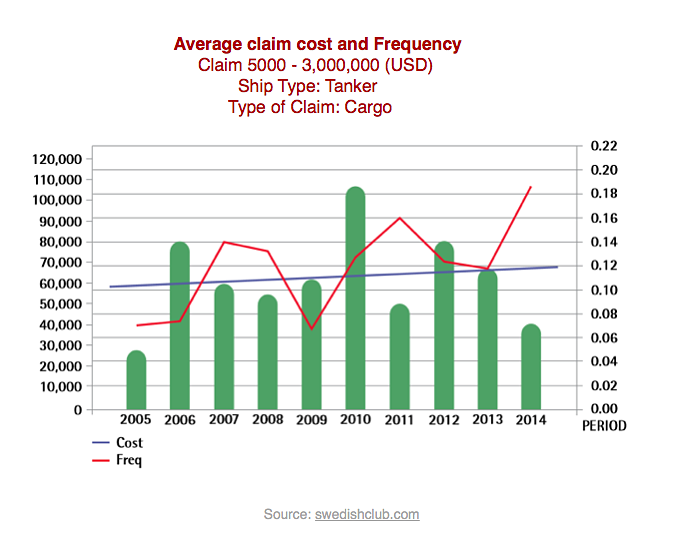
Sampling procedures on tanker There is no doubt that bill of lading is the most important aspect of commercial shipping. In my view the close second is the sampling of the cargo. Just as we need to be watchful for bill of ladings, we need to be equally concerned about sampling procedures we adopt. As per Swedish club, cargo contamination is the current major issue for chemical and product tankers. It would not be wrong to say that it is most costly type of claim too. Cargo claims The cost of cargo carried on board chemical tankers is sometimes more than the value of ship itself. And as such if the cargo is off spec at discharge port, it could be a disastrous situation. If the cargo is off spec during loading, there are two main sources for it. Contamination before the manifold valve and contamination after the manifold valves. Our job is to ensure is that there is no chance of contamination after the manifold. There can be many reason for cargo contamination after the manifold. This may include but not limited to 1) remains of previous cargo in the cargo lines 2) not properly washed tanks 3) Cargo temperatures or nitrogen padding not maintained as instructed But even when t...
Join now to access this article and much more.

Admin has placed this article behind a paywall, making it accessible only with a paid membership, which offers numerous perks:

  • Contribute to creating a platform for reading and writing without ads.
  • Enjoy all content here, including exclusive articles for members.
  • Gain access to all exclusive articles for members.

Comments (24)

  • abhishek May 13, 2016
    Thanks I m doing my orals. Ques. By looking from outside how will u differentiate betn 2 ships- One which is having DOA and one which isn’t having DOA. IS there any external marking.
    1
    Rajeev Jassal May 17, 2016
    Well I have not been on bulk carriers but I don't think there is any outside marking for this.
  • Sumanth August 3, 2016
    Useful information. Can you throw some light on the closed sampling arrangements at manifolds of a chemical tanker? Thank you.
    1
    Rajeev Jassal August 4, 2016
    There are no closed sampling arrangements for manifold. For this reason, generally manifold samples of toxic and corrosive cargoes are not permitted.
  • Navin Paliwal January 21, 2017
    Dear Capt Rajeev, i am so glad to see your blog up and running and indeed it is very detailed and informative.
    1
    Rajeev Jassal January 22, 2017
    Thank you Capt Navin..
  • Navin January 21, 2017
    The first foot and final tank sample can be taken either by running the cargo pump or by dip sampling method. Can you advise which one is the recommended method and why?
    3
    Rajeev Jassal January 22, 2017
    Both methods are widely used and nothing wrong with any one of these. However using dip sampling with closed samplers requires a lot of time as each time the sampler is lowered into a tank, it will draw sample to fill just one bottle. Considering the number of samples required these days, this method takes time. But this isn't case with cargoes for which we can do open sampling (such as palm oil). The problem with sampling by pump is if the cargo valves are leaking, it will fill the manifold line with cargo. There have been instances where cargo sampling was carried out with no manifold Blank and cargo spilled during sampling from the manifold because of leaking valves. Sampling of pump is also not recommended with solidifying cargoes such as Palm Styrene (Carriage temperature 70 C). This is because of obvious reason that if the cargo goes back in the manifold line it will choke the manifold line.
    navin January 22, 2017
    Thanks Capt Rajeev for your prompt reply. i have another point to discuss here. recently i loaded a cargo in which water content as per tank bottom sample was very close(but less than) to max permitted. my concern is that by the time vessel arrives at disport more water may settle at bottom and a bottom sample taken at disport (whether by pump of dip) may indicate water content above the permitted levels. what do you think can be done to safeguard owners interests in this situation.
  • navin paliwal January 26, 2017
    thanks Capt Rajeev. 1. pls advise if pump stack samples are always taken and analysed in case of WW cargoes like MEG/MEOH or does it vary from terminal to terminal. 2. can you name some typical cargoes for which only amber colored sample bottles should be used. What is the additional feature of amber bottles over clear glass bottles?
    3
    Rajeev Jassal January 27, 2017
    Terminal would in most of the cases not require pump stack samples. For them if manifold sample passes, their responsibility ceases. So usually it is Manifold samples, First foot and final samples. There are few instances where owner and/or charterers request pump stack samples. For example for cargoes that are Very expensive (nobody want to take a chance and want to know at each leg the quality of the cargo to minimise lose in case of sample fails) or very sensitive cargoes that require stringent cleaning requirement (more stringent than usual MEOH and MEG). One of such cargo is food grade Ethanol (the one usually loaded is industrial grade Ethanol). Since it is directly for the bottling and consumption, the pump stack samples are taken and analysed to ensure that quality of cargo entering the tank is OK. If it does not pass, then usually we drain few drums of cargo at the pump stack and check the sample again. This procedure is repeated and sometime close of 10 drums of 200 litres are drained before pump stack sample (in this case also called line sample) passes.
    Rajeev Jassal January 27, 2017
    Amber coloured bottles are used for cargoes that are affected by heat and sunlight. Like all polymerising cargoes. One such example is Styrene monomer. This is to avoid the sample heating up and loosing its quality. There are some other cargoes that changes color when under sunlight. The samples of these cargoes are also taken in amber coloured sample bottles. I do not see it as a written requirement anywhere but it comes under best practices of the trade. I am not sure of any other feature that these bottles may have.
  • navin January 30, 2017
    thank you Capt Rajeev for your prompt and precise replies.
    0
  • Joop Meijer February 1, 2017
    Your subject about sampling is a good piece of works and give a lot of information regarding the sampling methods. For me (Technical and distribution EHS Advisor) was this subject more then welcome. At this moment I'm trying to convinced my colleagues in the UK to step-over from open to closed sampling of toxic haz material. Off course they are afraid for contamination and extra time for sampling which could be resulted in waiting hours. Main question is, is it common practice that the vessel leave the terminal without the result of sample analysis ? Kind regards Joop Meijer
    1
    Rajeev Jassal February 1, 2017
    Hi Joop, The Initial samples (manifold and first foot) are taken to ensure that tanks are clean and cargo will not get contaminated once loaded. These samples are sent to lab for analysis and only after analysis passes, the cargo is loaded. But the final sample after loading is for evidence of the quality of cargo loaded. Vessel need not wait for the analysis of final sample. This is common in chemical /Product trade. Hope it helps.
  • Rogel Seradoy April 14, 2017
    What is the size of flame screen natural vent of cargo sample locker?
    0
  • Mate May 7, 2018
    hello Sir, very good blog you have here. can you tell me how would you record in ORB2 disposal of cargo samples (diesel,naphta,gasolines etc.) annex 1 into residual tank? does it need specific type of oil and quantity disposed to be recorded when they are disposed at same time? thanks in advance
    0
  • Manpreet behl May 21, 2020
    Thank u sir for such a nice blog. Very useful
    0
  • Anon August 24, 2020
    Hello, thank you for the article. Can you please explain how you got 425 m^2 for the surface area. I'm getting 243.85 m^2. The only way I was able to get close to your number was if I emulated a mistake and instead of doing the following: 15m(length of wall) x 4(# of walls) x 0.3048m(height of 1 foot in meters) + 225m(area of bottom), I did this: 15 x 4 x 3.28084(this is how many feet are in a meter). If my former calculation is correct, a first foot would cover around 18.36% of the total tank.
    0
  • Sunrise International Cargo and Courier March 16, 2021
    Sunrise International has the finest international courier and cargo equipped with significant expertise and knowledge of the industry. We have an exceptionally well-trained and professional team that aids all our processes. Moreover, we are proficient in managing the varied requirements of our clients with utmost efficiency. You can rely on us for speed, dependability and assurance with your international courier and cargo services. Therefore, if you want the best courier and cargo in Mumbai as well as internationally, Sunrise International can be the best choice.
    0
  • Pradip Sarma January 28, 2023
    Very nicely elaborated writeup on sampling procedures. Very useful
    0
  • Mamun Al Sharif July 12, 2024
    Hi Capt. Rajeev. Regarding cargo sample storage, is there any guide line for vertical/horizontal separation and how much should be the distance of sample bottles?
    0
Capt Rajeev Jassal

About Capt Rajeev Jassal

Capt. Rajeev Jassal has sailed for over 24 years mainly on crude oil, product and chemical tankers. He holds MBA in shipping & Logistics degree from London. He has done extensive research on quantitatively measuring Safety culture onboard and safety climate ashore which he believes is the most important element for safer shipping.

More like this

In blog, Cargo Operation

How confident are you about your ODMCS ?

Before we come to ODMCS tests, it is better to first do a recap on the requirements of ODMCS. ODMCS (Oil…

In blog, Cargo Operation, Maritime Law, Shipping Business

A Layman’s Guide to Laytime, Charter party Agreement and Voyage Charter

The word “Charterer” is probably as old as the word “Ship” itself. Do you keep hearing this word so regularly?…

In blog, Marine Conventions

Fall of Hanjin Shipping and other Maritime stories: September issue

Each month we bring to you the important happening from the maritime and shipping industry. We only bring the news…

In blog, Ship Navigation

How to plot navigational warnings on ECDIS (the right way) ?

1998 was the year when ECDIS got its first attention in a circular of Maritime safety committee of the IMO. But the mandatory requirement…

In blog, Cargo Operation, Ship Safety & Security

5 Tanker Terms That Can Help You in Being Safe On Tankers

Did you know a rich flammable mixture can ignite with just 1 Joule of energy ? If that does not…

In blog, Marine Engineering, Ship Navigation

GMDSS Batteries: Tests and checks mariners must know

GMDSS batteries provide power to GMDSS equipments in case ship’s main as well as emergency power fail. The requirement of…